
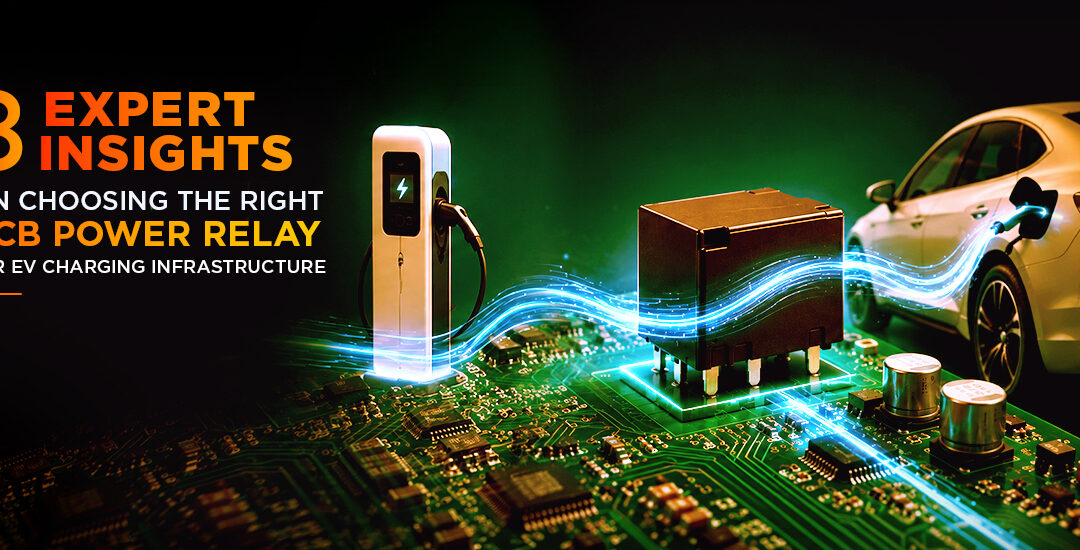
The global shift toward electric mobility is accelerating, making reliable EV charging infrastructure more important than ever. At the heart of every charging station, the PCB Power Relay plays a vital role in enabling high-current switching, protecting electrical circuits, and ensuring safe, efficient operation.
According to the International Energy Agency (IEA) Global EV Outlook 2025, global EV sales surpassed 17 million units in 2024, accounting for over 20% of new car sales worldwide. Additionally, BloombergNEF’s Electric Vehicle Outlook 2026 (June 2026) reported that the global public charging network expanded by 28% during 2025, reaching approximately 6.7 million public charging connectors.
With the rapid adoption of 800V and 1000V EV architectures, selecting the right PCB Power Relay has become essential for ensuring safety, efficiency, and long-term reliability in modern EV charging systems.
“Quality is never an accident; it is always the result of intelligent effort.” — John Ruskin
EV Charging Infrastructure Growth at a Glance
| Industry Indicator | Latest Data (2025–2026) |
| Global EV Sales (2024) | 17+ million vehicles |
| EV Share of New Car Sales | Over 20% globally |
| Public Charging Connectors | ~6.7 million |
| Growth in Charging Network (2025) | 28% YoY |
| Emerging EV Platforms | 800V & 1000V architectures |
Source: IEA Global EV Outlook 2025 and BloombergNEF Electric Vehicle Outlook 2026.
Why PCB Power Relay Selection Matters
Every EV charger relies on switching components to control electrical loads safely. A poorly selected relay can lead to overheating, contact welding, excessive power losses, unexpected downtime, and higher maintenance costs. As charging stations become faster and more power-dense, engineers must prioritize relay reliability to ensure uninterrupted operation and a longer service life.
8 Expert Insights on Choosing the Right PCB Power Relay
1. Select High Switching Capacity
Modern DC fast chargers deliver between 150 kW and 350 kW, while next-generation charging systems continue to push higher power levels. A PCB Power Relay should comfortably handle high inrush currents, continuous switching, and heavy electrical loads without compromising reliability. Selecting an under-rated relay can significantly reduce charger lifespan.
2. Evaluate Thermal Performance
Heat remains one of the leading causes of component degradation. High-performance relays with low contact resistance, efficient heat dissipation, and high-temperature insulation materials ensure stable performance under continuous-duty charging applications. Better thermal management directly improves operational reliability and reduces maintenance.
3. Prioritize Electrical Endurance
Commercial charging stations perform thousands of switching cycles annually. Choosing relays tested for high electrical and mechanical endurance minimizes contact wear and arc damage, resulting in lower replacement costs and improved charger uptime throughout the product lifecycle.
4. Verify Safety and Compliance
Reliable EV chargers must comply with international standards such as IEC, UL, RoHS, and REACH. Certified relays simplify regulatory approvals while ensuring consistent insulation performance, electrical safety, and long-term operational reliability across global markets.
5. Optimize PCB Space
As charging equipment becomes more compact, engineers need smaller yet powerful components. Compact PCB Power Relay designs allow higher PCB density, simplified layouts, and reduced enclosure sizes without sacrificing switching performance. This also contributes to more cost-effective manufacturing.
6. Ensure Superior Electrical Isolation
Modern EV chargers operate at increasingly higher voltages, making insulation performance crucial. Selecting relays with excellent dielectric strength, adequate creepage distance, and superior isolation between control and power circuits helps protect both equipment and users from electrical faults.
7. Choose Durable Contact Materials
The contact material largely determines relay longevity. Advanced silver alloy contacts offer lower oxidation, better conductivity, and reduced arcing, ensuring consistent switching performance even under demanding charging cycles. This becomes especially valuable for commercial chargers operating around the clock.
8. Prepare for Future Charging Technologies
The IEA Global EV Outlook 2026 highlights the growing adoption of 1000V battery platforms, ultra-fast charging, and bidirectional Vehicle-to-Grid (V2G) technology. Selecting relays designed for future voltage and current requirements helps manufacturers avoid costly redesigns while extending product relevance in a rapidly evolving EV ecosystem.
How LeOne Relay Powers Next-Generation EV Charging
As EV charging infrastructure advances, the quality of every switching component becomes increasingly important. Leone Relay develops high-performance relay solutions engineered for demanding power electronics applications where safety, endurance, and efficiency are paramount.
Designed to support high-current switching, excellent electrical isolation, compact PCB integration, and long operational life, Leone Relay’s products help OEMs and EV charger manufacturers build reliable charging systems capable of meeting today’s requirements while preparing for tomorrow’s higher-voltage technologies.
Key PCB Power Relay Selection Criteria
| Selection Parameter | Importance |
| Switching Capacity | Handles high charging currents safely |
| Thermal Performance | Prevents overheating and improves lifespan |
| Electrical Endurance | Supports frequent switching cycles |
| Safety Certifications | Ensures regulatory compliance |
| PCB Footprint | Enables compact charger design |
| Electrical Isolation | Protects users and equipment |
| Contact Material | Improves durability and reliability |
| Future Compatibility | Supports 800V, 1000V & V2G systems |
Conclusion
As EV charging infrastructure expands, choosing the right PCB Power Relay is essential for ensuring reliability, safety, thermal performance, and long-term efficiency. By integrating advanced relay technologies, manufacturers can improve charger uptime and reduce maintenance. LeOne Relay supports next-generation EV charging with dependable, high-performance relay solutions engineered for evolving power electronics applications.
Key Takeaways
- Global EV adoption is driving unprecedented demand for reliable charging infrastructure.
- A high-quality PCB Power Relay improves charger safety, efficiency, and operational lifespan.
- High switching capacity and thermal performance are essential for modern EV chargers.
- Electrical endurance reduces downtime and maintenance costs.
- Certified relays simplify compliance with international standards.
- Compact PCB designs enable smaller and more efficient charging equipment.
- Future-ready relay solutions support emerging 800V, 1000V, and V2G technologies.
- LeOne Relay delivers robust relay solutions engineered for next-generation EV charging applications.
 English
 Afrikaans
 Albanian
 Amharic
 Arabic
 Armenian
 Azerbaijani
 Basque
 Belarusian
 Bengali
 Bosnian
 Bulgarian
 Catalan
 Cebuano
 Chichewa
 Chinese (Simplified)
 Chinese (Traditional)
 Corsican
 Croatian
 Czech
Czech Danish
 Dutch
Dutch Esperanto
 Estonian
 Filipino
 Finnish
 French
 Frisian
 Galician
 Georgian
 German
 Greek
Greek Gujarati
 Haitian Creole
 Hausa
Hausa Hawaiian
 Hebrew
 Hindi
Hindi Hmong
Hmong Hungarian
 Icelandic
 Igbo
Igbo Indonesian
 Irish
Irish Italian
 Japanese
 Javanese
 Kannada
 Kazakh
 Khmer
Khmer Korean
 Kurdish (Kurmanji)
 Kyrgyz
 Lao
Lao Latin
Latin Latvian
 Lithuanian
 Luxembourgish
 Macedonian
 Malagasy
 Malay
Malay Malayalam
 Maltese
 Maori
Maori Marathi
 Mongolian
 Myanmar (Burmese)
 Nepali
 Norwegian
 Pashto
 Persian
 Polish
 Portuguese
 Punjabi
 Romanian
 Russian
 Samoan
 Scottish Gaelic
 Serbian
 Sesotho
 Shona
Shona Sindhi
 Sinhala
 Slovak
 Slovenian
 Somali
 Spanish
 Sudanese
 Swahili
 Swedish
 Tajik
Tajik Tamil
Tamil Telugu
 Thai
Thai Turkish
 Ukrainian
 Urdu
Urdu Uzbek
Uzbek Vietnamese
 Welsh
Welsh Xhosa
Xhosa Yiddish
 Yoruba
 Zulu
Zulu