
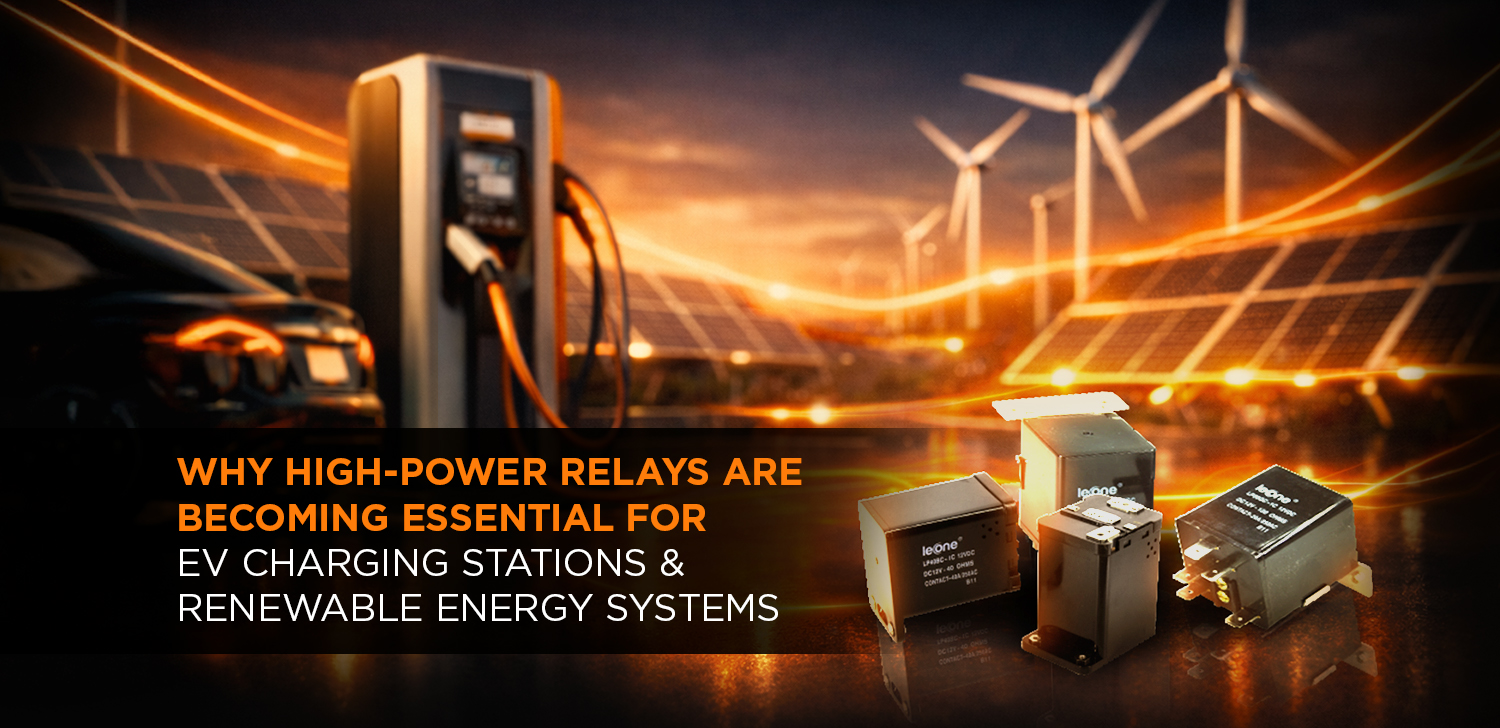
The global shift toward electric mobility and renewable energy has accelerated faster in 2024–2025 than ever before. As the world pushes for net-zero targets, the demand for high-power switching components, especially high-power relays has surged across EV charging infrastructure, solar farms, wind systems, and energy storage setups. These relays act as the “gatekeepers” of electrical circuits, enabling safe, reliable, and efficient current switching under high loads.
In November 2024, the International Energy Agency (IEA) reported that global EV sales crossed 17 million units, a 25% increase from 2023. At the same time, renewable capacity additions grew by 50%, marking the largest spike in the last three decades. With this exponential growth, the industry’s attention is now turning toward the crucial backbone components of high-power relays that ensure safety and continuity in these high-load environments.
As Tesla’s CEO Elon Musk once said, “Any system is only as strong as its weakest component.”
For EV and renewable systems, relays are the components no one can afford to overlook.
The Rising Load: Why Modern Charging Stations Need High-Power Relays
Rapid EV adoption is reshaping infrastructure requirements. A key challenge is managing the dramatically higher currents demanded by fast and ultra-fast chargers.
Growing Load Requirements
- According to a March 2025 report by BloombergNEF, global public fast-charging installations grew 36% year-over-year, with many new stations delivering 150 kW to 350 kW output.
- Level 3 DC fast chargers can carry currents up to 500A, making high-power relays indispensable for load switching, overload protection, and system isolation.
- A 2024 NREL (National Renewable Energy Laboratory) study found that relay failure accounted for 18% of EV charger downtime, making reliability a top priority for OEMs and infrastructure developers.
Safety at High Current
High-power relays ensure:
- Arc suppression
- High dielectric strength
- Reliable switching under inductive loads
- Thermal stability at extreme temperatures
As charging networks expand, uptime becomes a competitive differentiator. Reliable relay technology directly reduces operational losses, maintenance efforts, and downtime.
The Critical Role of Power Relays in Modern Energy Infrastructure
The transition to clean energy systems has increased dependence on Power Relays especially in high-voltage and high-current environments.
Why Power Relays Matter in Renewable Systems
Renewable power generation is inherently variable. Solar and wind systems demand dynamic switching, isolation, and load management, all of which require robust relay systems.
Latest Renewable Energy Insights (2024–2025)
- The UN Environment Programme (2024) noted renewable energy investments reached $623 billion, the highest ever.
- India’s solar capacity reached 87 GW in October 2024, with a target of 292 GW by 2030, driving massive demand for durable electrical components.
- A WindEurope 2025 report confirms that wind installations now rely on high-power relays capable of withstanding 1,000+ V switching and extreme operating conditions.
Where High-Power Relays Are Used in Renewable Energy Systems
- Solar Inverters & MPPT Systems: High-power relays ensure safe DC isolation and manage switching between grid modes.
- Battery Energy Storage Systems (BESS): Modern BESS can reach capacities of 100 MWh+, requiring relays that handle high surge currents and provide galvanic isolation.
- Wind Turbines: Turbine control systems rely on relays for pitch control, yaw control, and fault protection.
- Hybrid Energy Grids: Relays coordinate switching between solar, battery, grid, and diesel backup systems.
High-Power Relays: Enabling Future-Ready EV Charging Architecture
As cities upgrade public charging infrastructure, new standards emphasize efficiency, safety, and smart energy distribution.
Smart Charging & Load Balancing
According to a 2024 Frost & Sullivan EV charging study:
- Load balancing can reduce infrastructure strain by up to 40%.
- Smart chargers rely heavily on relays for real-time switching between power lines.
Grid Stability & Bidirectional Charging
The adoption of V2G (Vehicle-to-Grid) requires relays to:
- Manage bidirectional current flow
- Provide isolation to protect grid components
- Switch rapidly between charge and discharge states
With V2G projected to grow 30% annually through 2030 (IEA, 2024), demand for advanced relay systems will only increase.
What Makes Modern High-Power Relays Superior?
1. High Current Handling (Up to 1,000A)
Essential for fast chargers and industrial renewable systems.
2. High Voltage Tolerance (Up to 1,500V DC)
Required for solar arrays and EV DC chargers.
3. Long Electrical Life
Modern relays deliver 100,000+ switching cycles under full load.
4. Compact yet Durable Design
OEMs prefer slim relay profiles without compromising thermal performance.
5. EV-Grade Safety Compliance
Includes standards like:
- UL 508
- IEC 61810
- ISO 17409
- AEC-Q200 for automotive-grade components
6. Low Coil Power Consumption
Crucial for solar inverters and onboard EV chargers.
Industry Trends Driving Relay Adoption in 2025
1. Government Push for EV Infrastructure
- The US National Charging Network expansion (2025) funds 500,000 fast chargers, requiring millions of high-power relays.
- India’s FAME-II extension (Dec 2024) increased support for charging infrastructure, accelerating relay demand.
2. Surge in Renewable Energy Storage
BESS installations grew 85% in the first half of 2024, according to S&P Global.
3. Electrification of Industrial and Commercial Facilities
Data centers, manufacturing plants, and warehouses are adopting renewable microgrids—all dependent on robust relay systems.
4. Digitalization of Grid Systems
Smart grids need relays for automated switching and fault isolation.
Why Leone High-Power Relays Are the Ideal Choice for EV & Renewable Applications
Leone’s engineering excellence ensures:
- High thermal endurance for demanding EV loads
- Superior arc suppression technology
- Low contact resistance for optimal power efficiency
- Compliance with global safety certifications
Our relays are trusted in applications such as:
- EV fast chargers
- Solar and wind inverters
- Battery storage units
- Industrial power distribution
- Smart grid protective systems
As reliability becomes non-negotiable, Leone continues to innovate with next-gen relay technologies tailored for future-ready power systems.
Conclusion: The Future of Energy Depends on High-Power Relays
High-power relays have become indispensable as EV charging networks and renewable energy systems operate at higher voltages and demanding load conditions. Their ability to deliver safe, reliable, and efficient switching makes them a cornerstone of modern energy infrastructure. As global electrification accelerates, advanced relay technologies will continue to strengthen system performance, safety, and long-term reliability.
Key Takeaways
- Essential for high-current EV charging and renewable energy systems.
- Improve safety, uptime, and overall operational efficiency.
- Critical for emerging technologies like V2G and large-scale energy storage.
- Demand for high-power relays will rise significantly with global clean energy adoption.
 English
 Afrikaans
 Albanian
 Amharic
 Arabic
 Armenian
 Azerbaijani
 Basque
 Belarusian
 Bengali
 Bosnian
 Bulgarian
 Catalan
 Cebuano
 Chichewa
 Chinese (Simplified)
 Chinese (Traditional)
 Corsican
 Croatian
 Czech
Czech Danish
 Dutch
Dutch Esperanto
 Estonian
 Filipino
 Finnish
 French
 Frisian
 Galician
 Georgian
 German
 Greek
Greek Gujarati
 Haitian Creole
 Hausa
Hausa Hawaiian
 Hebrew
 Hindi
Hindi Hmong
Hmong Hungarian
 Icelandic
 Igbo
Igbo Indonesian
 Irish
Irish Italian
 Japanese
 Javanese
 Kannada
 Kazakh
 Khmer
Khmer Korean
 Kurdish (Kurmanji)
 Kyrgyz
 Lao
Lao Latin
Latin Latvian
 Lithuanian
 Luxembourgish
 Macedonian
 Malagasy
 Malay
Malay Malayalam
 Maltese
 Maori
Maori Marathi
 Mongolian
 Myanmar (Burmese)
 Nepali
 Norwegian
 Pashto
 Persian
 Polish
 Portuguese
 Punjabi
 Romanian
 Russian
 Samoan
 Scottish Gaelic
 Serbian
 Sesotho
 Shona
Shona Sindhi
 Sinhala
 Slovak
 Slovenian
 Somali
 Spanish
 Sudanese
 Swahili
 Swedish
 Tajik
Tajik Tamil
Tamil Telugu
 Thai
Thai Turkish
 Ukrainian
 Urdu
Urdu Uzbek
Uzbek Vietnamese
 Welsh
Welsh Xhosa
Xhosa Yiddish
 Yoruba
 Zulu
Zulu