
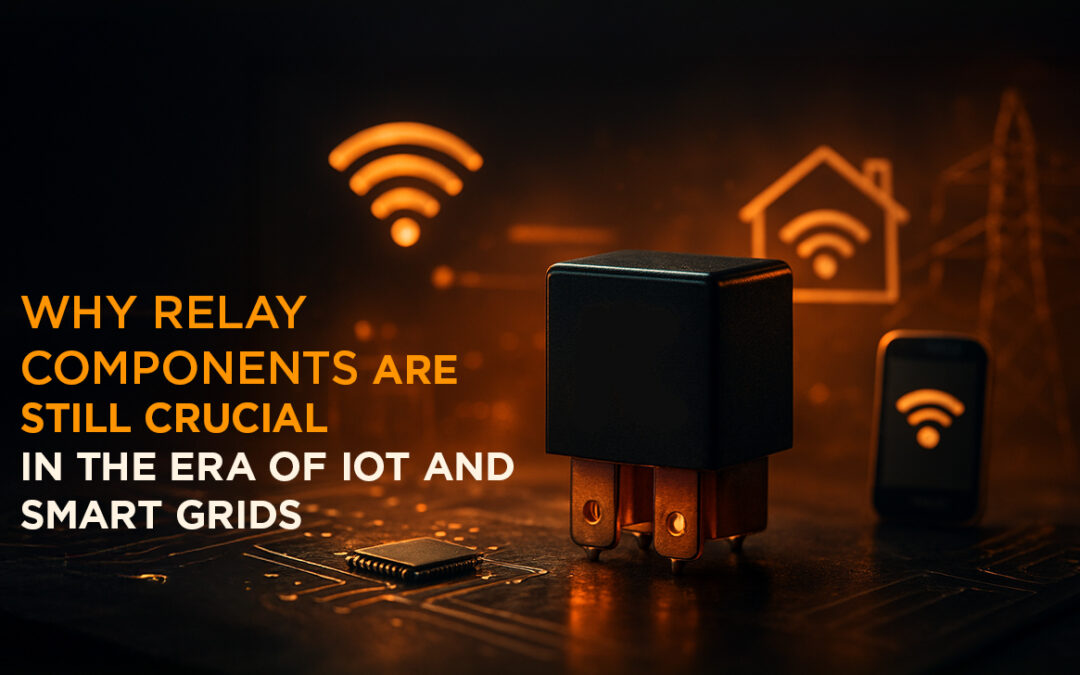
The global energy landscape is undergoing rapid digitalization, with the Internet of Things (IoT), smart grids, renewable integration and distributed generation reshaping how electricity is produced, transmitted and consumed. Yet, amidst advanced analytics, AI-driven automation and edge computing, relay components remain indispensable for ensuring reliability, safety and control.
According to a 2024 report by Straits Research, the global protective relay market was valued at USD 19.57 billion in 2024 and is projected to reach USD 37.74 billion by 2033, growing at a CAGR 6% of 7. This sustained growth reflects the crucial role of relays as enablers of secure and resilient grid infrastructure.
This article examines why relay components continue to be the bedrock of modern power systems, their integration with IoT and smart grids and the future opportunities and challenges that define their relevance.
Relay Components: The Foundation of Grid Protection
Relays in the Modern Grid
Relay components, whether electromechanical relays, solid-state relays, or microprocessor-based, act as the primary switching and protection devices in electrical systems. They are designed to:
- Detects overcurrent, under/overvoltage, frequency deviations, or ground faults.
- Isolate faulty sections to prevent cascading failures.
- Interface with communication networks for real-time protection and monitoring.
In 2025, research published in E3S Web of Conferences highlighted that IoT-integrated protective relays enable real-time monitoring of distribution systems, improving both stability and user-side energy visibility. Such hybrid systems are becoming standard in smart city projects across India and other emerging economies.
The Market Context: A Growing Reliance on Protection Systems
- BCC Research (2024) reported that the combined protective relays and circuit breakers market is set to grow from USD 16.9 billion in 2023 to USD 26.8 billion by 2029, driven by renewable adoption and digital grid upgrades.
- Juniper Research (September 2025) projects that smart grids will account for 43% of global electricity supply by 2030, compared to less than 25% in 2024. This transition underscores the growing demand for reliable protection mechanisms.
- In India, the government’s Revamped Distribution Sector Scheme (RDSS, 2024) allocated more than USD 12 billion for distribution modernization, including advanced relays and IoT-enabled protection equipment.
These figures confirm that relay components are not legacy devices, they are growth drivers in the evolving power ecosystem.
Relay Components in the Era of IoT and Smart Grids
IoT Integration: Beyond Mechanical Switching
In IoT-enabled grids, relays no longer function as isolated devices. Instead, they are part of a cyber-physical system, interfacing with:
- Sensors (temperature, voltage, current).
- Communication modules (5G, LPWAN, SCADA).
- Edge analytics for predictive fault detection.
A 2024 study in ScienceDirect emphasized that digital relays with adaptive settings significantly improve microgrid stability, especially with fluctuating renewable energy sources. This adaptability ensures grid resilience in an era of increasing DER (Distributed Energy Resources) penetration.
Self-Healing and Predictive Capabilities
Modern protective relays contribute to:
- Self-healing grids – automatic detection, isolation and rerouting of faults.
- Predictive maintenance – diagnostics that forecast failures before they occur.
- DER integration – handling bidirectional power flows and mitigating abnormal voltage or frequency excursions.
These capabilities make relays central to the operational success of smart grids.
Challenges and Opportunities
Cybersecurity and Standardization
With IoT integration, relays become part of digital networks creating new cybersecurity vulnerabilities. A 2024 arXiv paper on Trustable IoT-Coordinated Assets emphasized the need for secure communication protocols and firmware integrity in digital protective relays.
Standardization remains another challenge. Protocols such as IEC 61850 are enabling interoperability, but widespread adoption is still uneven, creating both risks and opportunities for manufacturers.
Transitioning from Electromechanical to Digital Relays
While electromechanical relays are valued for their robustness, the industry shift is toward solid-state relays and digital relays with enhanced functionality, faster response and remote configurability. Leone Relay’s product portfolio, including digital protection relays, positions the brand at the forefront of this transition.
Real-World Applications: Where Relays Prove Indispensable
- Smart Cities (India, 2025): IoT-enabled relays are being deployed in pilot smart city grids to enable consumer-level monitoring and automated fault isolation.
- Renewable Microgrids (Asia-Pacific): With solar and wind penetration exceeding 25% in some regional grids (IEA, 2024), adaptive digital relays are critical to preventing instability.
- EV Charging Infrastructure: Relay components ensure protection against overloads and surges as charging stations expand globally.
Conclusion
In the era of IoT and smart grids, relay components are not relics of the past;they are essential enablers of the future. They bridge the gap between mechanical reliability and digital intelligence, ensuring that grids are secure, adaptive and future-ready.
Key Insights:
- Relay components underpin fault detection, isolation and system reliability in modern grids.
- The protective relay market is expanding, driven by renewable integration and grid modernization.
- IoT enhances relay functionality, enabling predictive maintenance, self-healing and consumer transparency.
- Challenges such as cybersecurity and interoperability demand innovation and standardization.
- Leone Relay’s portfolio aligns with global trends, delivering solutions that support both legacy systems and next-generation smart grids.
As Thomas Edison once said, “The value of an idea lies in the use of it.” In the same way, the enduring value of relay components lies not just in their design, but in their deployment as the backbone of tomorrow’s intelligent energy systems.
Key Takeaways:
- Relay components remain indispensable for fault detection, isolation and overall grid protection.
- The protective relay market is growing steadily, reaching USD 37.74 billion by 2033.
- IoT integration enables relays to deliver predictive maintenance and self-healing capabilities.
- Digital relays with adaptive settings are crucial for DER and renewable-rich grids.
- Cybersecurity and interoperability are critical challenges in IoT-enabled relay systems.
- Leone Relay’s diverse portfolio positions it strongly for both legacy and smart grid applications.
 English
 Afrikaans
 Albanian
 Amharic
 Arabic
 Armenian
 Azerbaijani
 Basque
 Belarusian
 Bengali
 Bosnian
 Bulgarian
 Catalan
 Cebuano
 Chichewa
 Chinese (Simplified)
 Chinese (Traditional)
 Corsican
 Croatian
 Czech
Czech Danish
 Dutch
Dutch Esperanto
 Estonian
 Filipino
 Finnish
 French
 Frisian
 Galician
 Georgian
 German
 Greek
Greek Gujarati
 Haitian Creole
 Hausa
Hausa Hawaiian
 Hebrew
 Hindi
Hindi Hmong
Hmong Hungarian
 Icelandic
 Igbo
Igbo Indonesian
 Irish
Irish Italian
 Japanese
 Javanese
 Kannada
 Kazakh
 Khmer
Khmer Korean
 Kurdish (Kurmanji)
 Kyrgyz
 Lao
Lao Latin
Latin Latvian
 Lithuanian
 Luxembourgish
 Macedonian
 Malagasy
 Malay
Malay Malayalam
 Maltese
 Maori
Maori Marathi
 Mongolian
 Myanmar (Burmese)
 Nepali
 Norwegian
 Pashto
 Persian
 Polish
 Portuguese
 Punjabi
 Romanian
 Russian
 Samoan
 Scottish Gaelic
 Serbian
 Sesotho
 Shona
Shona Sindhi
 Sinhala
 Slovak
 Slovenian
 Somali
 Spanish
 Sudanese
 Swahili
 Swedish
 Tajik
Tajik Tamil
Tamil Telugu
 Thai
Thai Turkish
 Ukrainian
 Urdu
Urdu Uzbek
Uzbek Vietnamese
 Welsh
Welsh Xhosa
Xhosa Yiddish
 Yoruba
 Zulu
Zulu