
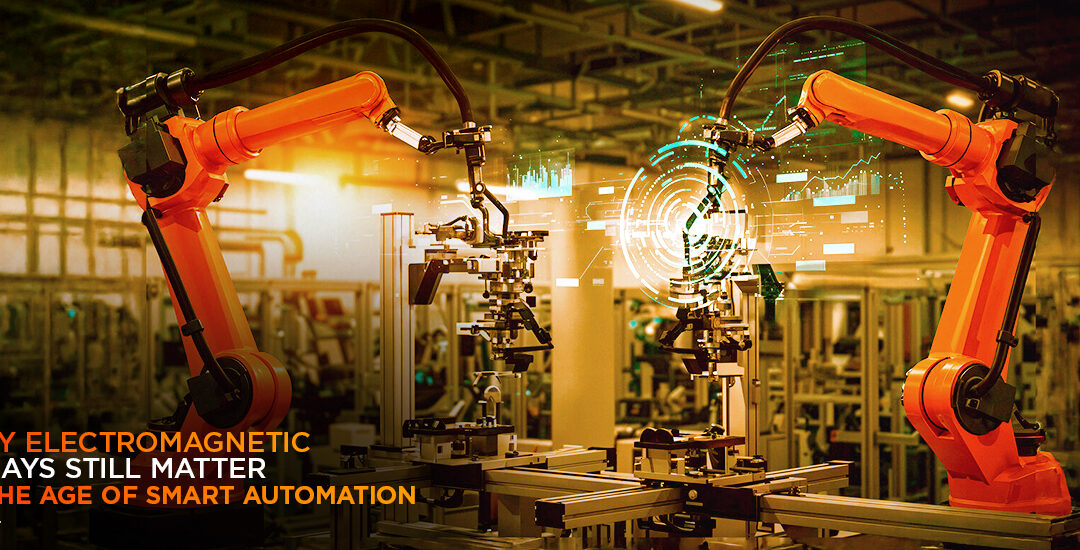
Imagine a modern factory floor. Sensors continuously monitor machines, PLCs process signals, robots perform repetitive tasks, and AI helps identify patterns that humans might miss. Everything appears increasingly digital and intelligent.
But when that intelligent system needs to switch a motor, activate a pump, operate a valve, control an HVAC unit or disconnect an electrical load, something still has to perform the physical switching.
This is where the electromagnetic relay continues to matter.
It may sound surprising that a technology based on an electromagnetic coil and mechanical contacts still has a place alongside AI, Industrial IoT (IIoT), robotics and edge computing. Yet modern automation isn’t about eliminating every conventional component. It is about combining proven hardware with increasingly intelligent control systems.
Deloitte’s 2025 Smart Manufacturing and Operations Survey, published on May 1, 2025, found that 92% of surveyed manufacturers believe smart manufacturing will be a major driver of competitiveness over the next three years. The same research found that 46% ranked process automation among their top two investment priorities.
So, if factories are becoming smarter, why aren’t electromagnetic relays disappearing?
Because smart automation still needs reliable ways to turn digital decisions into physical action.
What Is an Electromagnetic Relay?
An electromagnetic relay is an electrically operated switch that uses an electromagnetic field to mechanically change the state of its contacts.
The operating principle is straightforward:
Control signal → Coil energizes → Magnetic field develops → Armature moves → Contacts change state → Load is switched
The relay therefore acts as an interface between a control circuit and the circuit being switched.
For example, a PLC may determine that a pump needs to start. Instead of directly handling the load, the PLC can provide a control signal to a suitable relay. The relay then changes its contact state and allows the required electrical circuit to operate.
This simple architecture becomes valuable when control and load circuits have different electrical requirements or when isolation between circuits is desirable.
Why Electromagnetic Relays Still Matter in Smart Automation
The rise of smart automation has actually made the distinction between decision-making and physical switching more important.
1. They Connect Digital Intelligence With Physical Action
AI can analyse production data. An IIoT sensor can detect a temperature change. A PLC can process a machine condition.
But none of those technologies, by themselves, physically open or close a conventional electrical circuit.
A relay can form the missing link:
Sensor → Controller → Relay → Machine
Consider an automated cooling system. A temperature sensor detects that a room has exceeded its defined threshold. The controller processes the signal and issues a command. The relay then switches the appropriate circuit controlling the equipment.
The intelligence is digital. The action is physical.
That distinction explains why a relatively simple component can remain part of an advanced automation architecture.
2. Electrical Isolation Remains Important
Industrial environments can contain motors, contactors, solenoids and other electrically noisy loads. Control electronics may operate at different voltage levels from the equipment they command.
A suitable electromagnetic relay can provide electrical separation between the coil/control side and the switched contacts, helping designers interface control electronics with field equipment appropriately.
This makes relays useful in control panels, industrial machinery, building automation and other applications where dependable circuit interfacing matters.
3. Proven Technology Has Value
Newer does not automatically mean better for every application.
Electromagnetic relays have a well-established operating principle, widely understood specifications, and familiar maintenance practices. Engineers can select them according to parameters such as coil voltage, contact configuration, switching capacity, electrical life and mechanical life.
That predictability can be valuable in industrial environments where component selection must consider the complete operating system rather than technology trends alone.
Smart Automation Is Growing and So Is the Need for Physical Automation
Recent industry research illustrates just how quickly automation architectures are developing.
| Smart manufacturing indicator | Latest reported figure |
| Manufacturers expecting smart manufacturing to drive competitiveness | 92% |
| Ranking process automation as a top-two investment priority | 46% |
| Prioritizing factory automation hardware over the next 24 months | 41% |
| Using Industrial IoT at facility/network level | 46% |
| Using AI/ML at facility/network level | 29% |
| Using 5G at facility/network level | 42% |
| Average improvement in production output reported after implementation | 10%–20% |
Source: Deloitte 2025 Smart Manufacturing and Operations Survey, based on responses from 600 manufacturing executives.
The numbers reveal something important: manufacturers are adopting sensors, IIoT, AI and advanced analytics, but they are also continuing to invest in factory automation hardware.
That is where components such as relays remain relevant.
Electromagnetic Relay vs Solid-State Relay: Which One Fits?
It is tempting to assume that a solid-state relay must replace an electromagnetic relay simply because it has no mechanical contacts. In practice, the decision depends on the application.
| Requirement | Electromagnetic Relay | Solid-State Relay |
| Switching mechanism | Mechanical contacts | Semiconductor devices |
| Mechanical contact wear | Yes | No |
| Silent operation | Not necessarily | Yes |
| High-frequency switching | Less suitable for some applications | Generally better suited |
| Electrical isolation | Available in suitable designs | Available |
| Typical strength | Flexible electromechanical switching | High-cycle electronic switching |
Electromagnetic relays can be appropriate where contact-based switching, isolation, versatility and established electrical characteristics are important. Solid-state solutions may be preferable where high switching frequency, silent operation or the absence of mechanical wear is a priority.
The important question isn’t “Which relay is newer?”
It is:
“Which switching technology matches the electrical and operating requirements of the application?”
Where Electromagnetic Relays Are Finding Their Place in 2026
The evolution of relay technology itself provides an interesting answer.
Leone’s LHDC electromagnetic relay specification, for example, lists 12 VDC, 24 VDC and 110 VDC coil options, contact configurations of 1A/1C, and contact capacities including 55A at 60VDC for specified configurations. The datasheet also specifies a mechanical life of 1 million cycles, a 15 ms operate time, a 15 ms release time and an operating temperature range of −40°C to +85°C. Applications listed include motor forklifts, high-voltage-system accessories, air-conditioning and electric-control systems for electromobility.
This illustrates how today’s electromagnetic relays aren’t simply copies of older designs. They are being developed for increasingly specialized requirements, including compact equipment and electrified mobility.
At the same time, Leone’s broader relay portfolio demonstrates how different relay configurations can address different voltage, current, mounting and control requirements.
What Should You Consider When Choosing an Electromagnetic Relay?
Selecting an electromagnetic relay requires more than matching the coil voltage.
Engineers should consider:
- Coil voltage and coil power
- Contact configuration, such as NO, NC, SPDT or DPDT
- AC or DC load
- Resistive or inductive load
- Maximum switching voltage and current
- Electrical life and mechanical life
- Operate and release time
- Insulation and dielectric strength
- Operating temperature
- Mounting and terminal configuration
- Environmental conditions and application requirements
Inductive loads such as motors and solenoids deserve particular attention because switching them can generate transient voltages. Appropriate circuit protection and relay selection should therefore be considered as part of the overall design.
The Future of Automation Isn’t Relay vs AI It’s Relay With AI
The conversation around automation is increasingly shifting toward intelligent and connected systems.
The World Economic Forum’s Intelligent Industrial Operations Outlook 2026, published on April 16, 2026, describes industrial operations moving from traditional automation toward systems that are increasingly intelligent, connected and autonomous.
Its June 2026 Human-Machine Collaboration research also highlights how industrial operations are evolving as AI and automation become more integrated. The Forum estimates that three in four industrial jobs are expected to evolve over the next decade, with around 40% of future industrial skills classified as new or emerging.
This points toward an important reality: the future factory will contain layers of technology rather than one technology replacing everything else.
A single automation architecture could combine:
AI → Analytics → IIoT Sensors → PLC/Controller → Relay → Actuator → Machine
Each component has a different responsibility.
AI interprets.
Sensors detect.
Controllers decide.
Relays switch.
Actuators move.
Machines perform.
Conclusion: Smart Automation Still Needs Reliable Switching
The electromagnetic relay may not be the most digitally sophisticated component on a modern factory floor, but sophistication isn’t always the objective. Reliable interaction between control systems and physical equipment is.
As automation becomes more intelligent, electromagnetic relays can continue to serve as practical switching and interfacing components where their electrical and mechanical characteristics match the application.
Key Takeaways
- Electromagnetic relays remain relevant because smart systems still need physical switching.
- They can provide an interface between controllers and electrical loads.
- Electrical isolation remains an important consideration in industrial control architectures.
- Solid-state relays offer different advantages and are better suited to certain applications.
- Relay selection should consider coil characteristics, contact ratings, load type, switching frequency, life and environmental conditions.
- Modern automation is increasingly built from interconnected technologies, rather than one technology replacing everything else.
- The future is not necessarily about choosing between intelligent automation and proven components it is about integrating both effectively.
In 2026, factories may be getting smarter, but the fundamental need to safely and reliably control physical equipment has not disappeared. And that is precisely why the electromagnetic relay still matters.
 English
 Afrikaans
 Albanian
 Amharic
 Arabic
 Armenian
 Azerbaijani
 Basque
 Belarusian
 Bengali
 Bosnian
 Bulgarian
 Catalan
 Cebuano
 Chichewa
 Chinese (Simplified)
 Chinese (Traditional)
 Corsican
 Croatian
 Czech
 Danish
 Dutch
 Esperanto
 Estonian
 Filipino
 Finnish
 French
 Frisian
 Galician
 Georgian
 German
 Greek
 Gujarati
 Haitian Creole
 Hausa
 Hawaiian
 Hebrew
 Hindi
 Hmong
 Hungarian
 Icelandic
 Igbo
 Indonesian
 Irish
 Italian
 Japanese
 Javanese
 Kannada
 Kazakh
 Khmer
 Korean
 Kurdish (Kurmanji)
 Kyrgyz
 Lao
 Latin
 Latvian
 Lithuanian
 Luxembourgish
 Macedonian
 Malagasy
 Malay
 Malayalam
 Maltese
 Maori
 Marathi
 Mongolian
 Myanmar (Burmese)
 Nepali
 Norwegian
 Pashto
 Persian
 Polish
 Portuguese
 Punjabi
 Romanian
 Russian
 Samoan
 Scottish Gaelic
 Serbian
 Sesotho
 Shona
 Sindhi
 Sinhala
 Slovak
 Slovenian
 Somali
 Spanish
 Sudanese
 Swahili
 Swedish
 Tajik
 Tamil
 Telugu
 Thai
 Turkish
 Ukrainian
 Urdu
 Uzbek
 Vietnamese
 Welsh
 Xhosa
 Yiddish
 Yoruba
 Zulu