
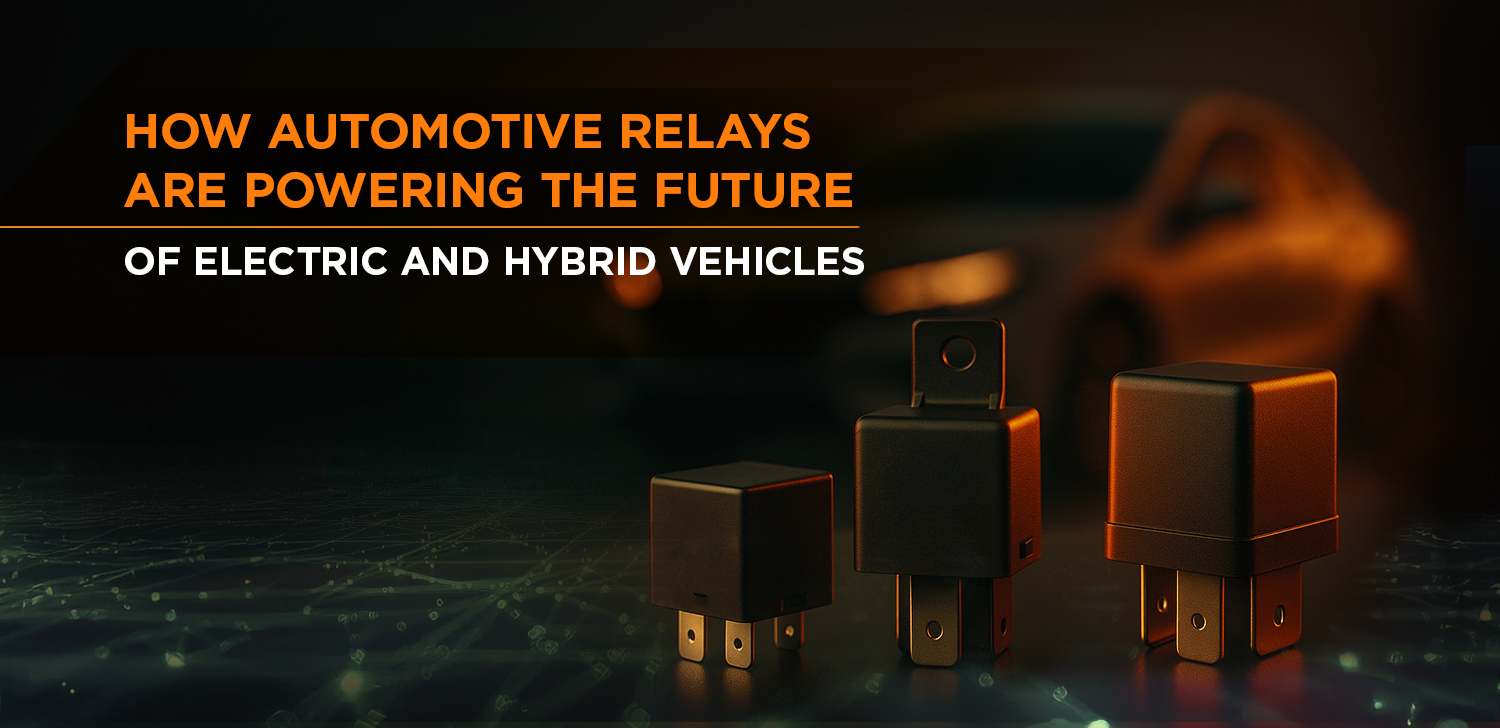
As the global shift toward electrification accelerates, a quiet but powerful component is shaping the performance, reliability and safety of modern electric and hybrid vehicles automotive relays. These compact electromagnetic switches are no longer simple on/off devices; today, they are at the core of high-voltage battery management, thermal systems, advanced driver-assistance features and charging infrastructure.
According to the International Energy Agency (IEA) Global EV Outlook 2024, EV sales grew by 35% year-over-year, crossing 14 million units worldwide, strengthening forecasts that EVs will account for 45% of global vehicle sales by 2030. With this exponential growth, demand for high-performance relays is projected to increase by over 18% annually (MarketsandMarkets, July 2024).
In this fast-transforming mobility ecosystem, relays are not just components, they are critical enablers that ensure the safe flow of power across increasingly complex vehicle electrical architectures.
Why Automotive Relays Matter in Next-Gen EV Engineering
Automotive electrical systems are becoming more layered, intelligent and high-voltage intensive. This is where automotive relays step in, providing controlled switching and safety isolation between power sources and subsystems.
A January 2025 report from McKinsey’s EV Component Reliability Index notes that over 63% of EV functional failures are linked to electrical subsystem instability, highlighting the need for robust relay technology with enhanced thermal endurance and arc suppression capabilities.
Relays in EVs and hybrids now handle:
- High-voltage battery disconnection
- Motor control and inverter switching
- DC fast charging operations
- Auxiliary systems like HVAC, pumps, lights and infotainment
- Protecting circuits from overloads and faults
As Elon Musk famously said, “Any product that’s high-performance is a symphony of small components working in perfect harmony.”
Relays are among those components enabling that harmony in EV powertrains.
The Rise of High-Voltage Architectures and What It Means for Automotive Relays
EV manufacturers are moving from 400V systems to 800V and even 1000V architectures to enable ultra-fast charging and reduce thermal losses. Porsche, Hyundai and BYD already use 800V systems and according to an August 2024 Reuters automotive report, most global OEMs will adopt 800V platforms by 2027.
This shift has amplified demand for relays with:
- Higher dielectric strength
- Superior arc suppression technologies
- Extended current endurance
- Low contact resistance
A 2024 study published in the Journal of Power Electronics & Transport Systems showed that 800V EV platforms increase relay switching loads by 40–60%, making advanced relay design essential.
Automotive Relays in EV Battery Management Systems (BMS)
The Battery Management System is the heart of an electric vehicle. Automotive relays protect this heart by:
- Providing safe isolation between high-voltage components
- Enabling pre-charge circuits to avoid battery surges
- Supporting thermal control loops through coolant pumps and fans
- Ensuring emergency shutdown during overcurrent or collision events
In November 2024, LG Energy Solution announced new research indicating that relay-based BMS protection reduces thermal runaway probability by 23%, reinforcing how crucial high-reliability relays are for battery safety compliance.
As EV batteries grow in capacity from 60 kWh to 120 kWh and beyond relay performance must scale accordingly.
How Automotive Relays Support Fast Charging and Power Electronics
The Role of Automotive Relays in Fast-Charging Systems (H3)
With EV owners demanding quicker charging times, fast-charging infrastructure is expanding rapidly. The IEA 2024 EV Infrastructure Report recorded a 55% increase in DC fast-charger installations globally, with India itself seeing 146% growth in public charging stations in 2024, driven by FAME II and state EV policies.
Fast charging increases power surges, thermal spikes and switching cycles. Automotive relays help maintain system reliability by:
- Managing high-current switching
- Protecting circuits from reverse current
- Reducing coil power consumption
- Preventing overheating during rapid charge cycles
A 2025 BloombergNEF survey states that relay-based protection reduces charging downtime by up to 31%, improving station uptime and user experience.
Automotive Relays in Hybrid Vehicles: Managing Dual Power Sources
Hybrid Electric Vehicles (HEVs) require relays to manage seamless transition between:
- Internal combustion engine (ICE)
- Electric motor
- Battery pack
- Regenerative braking systems
Toyota’s 2024 Hybrid Efficiency Study reveals that relay-controlled regenerative braking improves energy recovery by nearly 27%, supporting higher fuel savings and emissions reduction.
Relays also provide:
- High-speed switching between power sources
- Load optimization to reduce battery drain
- Safety cut-offs in high-temperature conditions
With HEVs continuing to grow in Asian markets especially India, Japan and Indonesia the demand for hybrid-compatible relays is set for sustained growth.
Why Reliability, Durability and Safety Standards Matter in Modern Relays
Automotive environments operate under extreme conditions—heat, vibration, moisture and voltage fluctuations. A 2024 TÜV SÜD component certification review shows that relay failure rates drop by 70% when manufacturers use:
- Silver alloy contacts
- Multi-layer arc chambers
- Reinforced coil insulation
- Hermetically sealed construction
The latest ISO and IEC relay standards (updated mid-2024) focus on:
- Dielectric strength
- Endurance cycle testing
- Contact welding resistance
- Thermal stability
For a component expected to perform millions of switching cycles, quality is non-negotiable.
EV Trends of 2025 That Will Accelerate Automotive Relay Adoption
1. Solid-State Relays (SSR) Will Complement Traditional Electromechanical Relays
With the EV market favoring silent and faster switching, SSR adoption is projected to grow 22% CAGR through 2030.
2. Growth of Connected and Autonomous EVs
Autonomous sensors, LiDAR, cameras and ADAS systems rely heavily on low-power PCB relays.
3. Thermal Management Evolution
Modern EVs use multiple relay-controlled coolant valves and pumps for battery and motor cooling.
4. Expansion of 350kW–500kW Ultra-Fast Chargers
These require high-voltage DC relays for surge protection and power distribution.
As Henry Ford once said: “Quality means doing it right when no one is looking.”
In the EV era, automotive relays embody this principle—quietly ensuring safety, efficiency, and power continuity.
Conclusion: A Future Driven by Smarter, Safer Automotive Relays
Automotive relays have evolved from simple switches into critical guardians of EV and hybrid vehicle power systems. As electrification accelerates worldwide, the importance of robust, high-voltage, long-life relay technology grows even stronger.
Key Takeaways
- EV sales surged by 35% in 2024, increasing demand for advanced relay systems.
- High-voltage 800V architectures require relays with superior endurance and thermal stability.
- Modern relays play a central role in BMS protection, fast charging, hybrids, and ADAS systems.
- Global studies demonstrate relay-driven improvements in safety, efficiency, and charging reliability.
- The future EV ecosystem will rely on smart, durable, safety-compliant relays to power next-generation mobility.
 English
 Afrikaans
 Albanian
 Amharic
 Arabic
 Armenian
 Azerbaijani
 Basque
 Belarusian
 Bengali
 Bosnian
 Bulgarian
 Catalan
 Cebuano
 Chichewa
 Chinese (Simplified)
 Chinese (Traditional)
 Corsican
 Croatian
 Czech
Czech Danish
 Dutch
Dutch Esperanto
 Estonian
 Filipino
 Finnish
 French
 Frisian
 Galician
 Georgian
 German
 Greek
Greek Gujarati
 Haitian Creole
 Hausa
Hausa Hawaiian
 Hebrew
 Hindi
Hindi Hmong
Hmong Hungarian
 Icelandic
 Igbo
Igbo Indonesian
 Irish
Irish Italian
 Japanese
 Javanese
 Kannada
 Kazakh
 Khmer
Khmer Korean
 Kurdish (Kurmanji)
 Kyrgyz
 Lao
Lao Latin
Latin Latvian
 Lithuanian
 Luxembourgish
 Macedonian
 Malagasy
 Malay
Malay Malayalam
 Maltese
 Maori
Maori Marathi
 Mongolian
 Myanmar (Burmese)
 Nepali
 Norwegian
 Pashto
 Persian
 Polish
 Portuguese
 Punjabi
 Romanian
 Russian
 Samoan
 Scottish Gaelic
 Serbian
 Sesotho
 Shona
Shona Sindhi
 Sinhala
 Slovak
 Slovenian
 Somali
 Spanish
 Sudanese
 Swahili
 Swedish
 Tajik
Tajik Tamil
Tamil Telugu
 Thai
Thai Turkish
 Ukrainian
 Urdu
Urdu Uzbek
Uzbek Vietnamese
 Welsh
Welsh Xhosa
Xhosa Yiddish
 Yoruba
 Zulu
Zulu