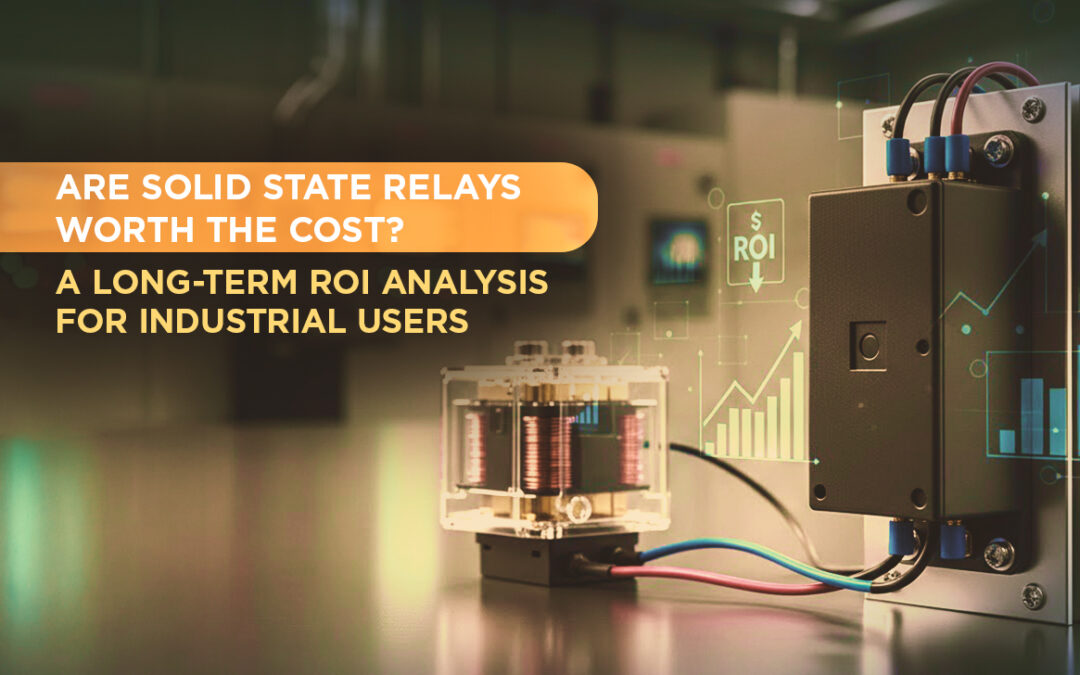
In an era where industrial efficiency and reliability can make or break operations, the choice of components impacts not just performance but profitability. Among these critical components, Solid State Relays (SSRs) have become a topic of intense discussion.
At first glance, SSRs may seem costlier than traditional Electromechanical Relays (EMRs). But when evaluated through the lens of total cost of ownership (TCO) and long-term return on investment (ROI), their value often becomes unmistakable.
This blog dives into data, trends, and real-world comparisons backed by the latest industry reports from 2024 and 2025, to help industrial decision-makers answer the critical question: Are Solid State Relays worth the cost?
The Market Says “Yes”: Growing Adoption and Demand
The global market for Solid State Relays has been expanding rapidly, a clear indicator of industrial confidence in the technology.
- In 2024, independent market analysis valued the SSR market at USD 1.42 billion, with strong mid-term growth expected.
- By 2025, multiple industry forecasts project the market to be between USD 1.59 billion and USD 1.74 billion.
- Some longer-term models even estimate growth to USD 2.36 billion by 2030 at a steady CAGR of ~6.3 %.
Across regions and sectors from Asia-Pacific automation hubs to automotive and energy infrastructure SSRs are quickly becoming the preferred switching solution due to efficiency and robustness.
What Makes Solid State Relays Different?
Unlike electromechanical relays, SSRs have no moving parts, instead relying on semiconductor components like TRIACs or MOSFETs to switch loads electronically.
This design difference creates several unique advantages:
- Faster switching speeds
- No physical contact wear
- Silent operation
- Lower electrical noise
All these contribute to improved reliability and longevity crucial factors in industrial environments where downtime can cost orders of magnitude more than the device price itself.
Comparing Costs — First Investment vs. Lifetime Value
Initial Cost
Yes, SSRs typically carry higher upfront costs than EMRs. Analysis from industry cost studies confirms this trend: SSRs cost more initially but deliver greater efficiency over time.
Long-Term Savings
When you factor in maintenance, replacements, downtime, and performance, SSRs can be significantly more economical:
- No moving contacts- Virtually eliminates contact wear and arcing
- Extended lifespan- Less frequent replacements
- Reduced maintenance labor- Fewer service interrupts
Industry sources repeatedly highlight that while EMRs are cheaper to buy, SSRs often cost less over equipment lifetime due to reduced maintenance and failure-related expenses.
Real-World Industrial Advantages That Drive ROI
1. Higher Reliability, Less Downtime
In high-cycle environments (such as automated assembly lines), the absence of moving parts means SSRs degrade much more slowly than mechanical relays.
For businesses where even an hour of downtime can cost thousands, SSR reliability translates directly to better uptime and productivity.
2. Lower Maintenance Costs
SSRs drastically cut back the need for:
- Relay replacements
- Periodic contact cleaning
- Service labor
This can translate into double-digit percent reductions in maintenance budgets over multi-year cycles, especially for facilities operating 24/7.
3. Energy Efficiency and Heat Management
Although switching itself doesn’t save huge amounts of energy, SSRs often:
- produce less heat than EMRs in similar applications
- eliminate arcing and mechanical inefficiencies
This thermal efficiency reduces strain on power systems and cooling infrastructure particularly important in high-density industrial cabinets and manufacturing cells.
4. Precision and High-Frequency Switching
SSRs are ideal for applications requiring rapid or precise control such as:
- PLC output stages
- Servo and motion control
- Thermal process control systems
Their microsecond-level switching gives process engineers greater control and accuracy — which is especially valuable in advanced automated plants.
The ROI Equation: A Practical Example
Here’s a simplified ROI comparison based on typical industrial usage:
| Factor | Electromechanical Relay | Solid State Relay |
| Initial Cost | Lower | Higher |
| Lifespan | Shorter | Longer |
| Maintenance | Frequent | Minimal |
| Downtime Costs | Higher | Lower |
| Total 5-Year Cost (Hypothetical) | High | Significantly Lower |
Most industrial benchmarks show that even with higher upfront cost, SSRs often deliver 30-60 % lower total cost of ownership over typical 5-7-year equipment lifetimes when factoring in maintenance, failure, and production losses.
When SSRs Make the Most Sense
Here are environments where SSRs typically justify their cost fastest:
- High cycle or continuous operation
- Automated production lines
- Precision process control (e.g., temperature, motion, robotics)
- Systems where maintenance interruption equates to major financial loss
- Harsh environments with vibration, dust, or heat
In these cases, the cost-per-performance ratio of SSRs usually outperforms that of EMRs within the first few years.
Conclusion
Solid State Relays deliver clear long-term value for industrial users when evaluated beyond upfront cost. Their reliability, minimal maintenance, and ability to reduce downtime make them a strong investment in high-demand and automated environments. As industries continue to prioritize efficiency and uptime, SSRs align well with modern operational needs. When total cost of ownership is considered, Solid State Relays often prove more economical than traditional alternatives.
Key Takeaways
- Solid State Relays offer superior reliability with no mechanical wear.
- Higher initial cost is offset by long-term savings and reduced downtime.
- Ideal for high-frequency and automation-driven industrial applications.
- Lower maintenance requirements improve operational efficiency.
- Total cost of ownership often favors SSRs over mechanical relays.
 English
 Afrikaans
 Albanian
 Amharic
 Arabic
 Armenian
 Azerbaijani
 Basque
 Belarusian
 Bengali
 Bosnian
 Bulgarian
 Catalan
 Cebuano
 Chichewa
 Chinese (Simplified)
 Chinese (Traditional)
 Corsican
 Croatian
 Czech
Czech Danish
 Dutch
Dutch Esperanto
 Estonian
 Filipino
 Finnish
 French
 Frisian
 Galician
 Georgian
 German
 Greek
Greek Gujarati
 Haitian Creole
 Hausa
Hausa Hawaiian
 Hebrew
 Hindi
Hindi Hmong
Hmong Hungarian
 Icelandic
 Igbo
Igbo Indonesian
 Irish
Irish Italian
 Japanese
 Javanese
 Kannada
 Kazakh
 Khmer
Khmer Korean
 Kurdish (Kurmanji)
 Kyrgyz
 Lao
Lao Latin
Latin Latvian
 Lithuanian
 Luxembourgish
 Macedonian
 Malagasy
 Malay
Malay Malayalam
 Maltese
 Maori
Maori Marathi
 Mongolian
 Myanmar (Burmese)
 Nepali
 Norwegian
 Pashto
 Persian
 Polish
 Portuguese
 Punjabi
 Romanian
 Russian
 Samoan
 Scottish Gaelic
 Serbian
 Sesotho
 Shona
Shona Sindhi
 Sinhala
 Slovak
 Slovenian
 Somali
 Spanish
 Sudanese
 Swahili
 Swedish
 Tajik
Tajik Tamil
Tamil Telugu
 Thai
Thai Turkish
 Ukrainian
 Urdu
Urdu Uzbek
Uzbek Vietnamese
 Welsh
Welsh Xhosa
Xhosa Yiddish
 Yoruba
 Zulu
Zulu