
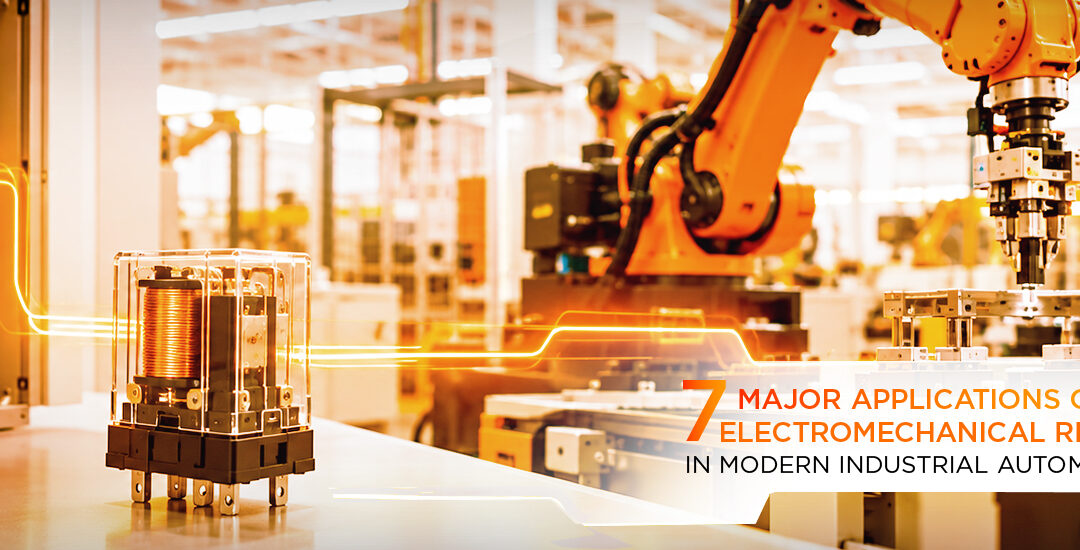
What connects a PLC’s control signal to a physical machine? In many industrial automation systems, the answer can be a surprisingly simple component: an electromechanical relay.
Modern factories are increasingly adopting robotics, artificial intelligence, Industrial IoT (IIoT), machine vision, and connected production systems. Yet these technologies still depend on reliable electrical components to switch circuits, provide isolation, and connect controllers with field equipment.
The scale of this transformation is significant. The International Federation of Robotics (IFR) reported that 542,000 industrial robots were installed globally in 2024, while India recorded 9,120 industrial robot installations, an increase of 7% compared with the previous year.
As industrial automation becomes more sophisticated, understanding where an electromechanical relay fits into the overall control architecture becomes increasingly important.
What Is an Electromechanical Relay?
An electromechanical relay is an electrically operated switching device that uses an electromagnetic coil and mechanical contacts to control another electrical circuit.
Its basic operating principle is straightforward:
Control signal → Coil energizes → Magnetic field develops → Armature moves → Contacts change state → Circuit switches
The primary relay contacts are:
- COM (Common): The common switching terminal.
- NO (Normally Open): Remains open until the relay is energized.
- NC (Normally Closed): Remains closed until the relay is energized.
Depending on its configuration, an industrial relay can provide switching, electrical isolation, signal interfacing, and interlocking.
A typical automation architecture can therefore look like:
Sensor → PLC/Controller → Electromechanical Relay → Contactor/Actuator → Machine
The relay does not make the control decision. Instead, it helps connect the controller’s decision to the electrical circuit that performs the required action.
2025–2026 Industrial Automation: Key Data
The latest manufacturing and automation data provides useful context for understanding why dependable control hardware continues to matter.
| Industry indicator | Latest available data | Source |
| Industrial robots installed globally | 542,000 | IFR, 2025 |
| Global operational industrial robot stock | 4.66 million | IFR, 2025 |
| India’s industrial robot installations | 9,120 | IFR, 2025 |
| India’s annual robot installation growth | 7% | IFR, 2025 |
| Global manufacturers considering digital transformation essential | 90% | Rockwell Automation, 2026 |
| APAC manufacturers considering digital transformation essential | 95% | Rockwell Automation, 2026 |
| Manufacturers actively using smart-manufacturing technologies | 59% | Rockwell Automation, 2026 |
| APAC manufacturers planning increased AI/ML use | 71% | Rockwell Automation, 2026 |
| India’s manufacturing GVA growth—Q1 FY2025–26 | 7.72% | Government of India, 2026 |
| India’s manufacturing GVA growth—Q2 FY2025–26 | 9.13% | Government of India, 2026 |
| Medium- and high-technology industries’ share of manufacturing value added | 46.3% | Government of India, 2026 |
These figures describe the wider automation environment; they should not be interpreted as direct measurements of relay adoption.
7 Major Applications of Electromechanical Relays in Industrial Automation
1. Motor Control and Switching
Motors are fundamental to industrial automation. They power conveyors, pumps, compressors, fans, machine tools, and production equipment.
An electromechanical relay can operate within the control circuit between a PLC and a contactor or another switching device.
PLC → Relay → Contactor → Motor
In this arrangement, the relay may provide control-signal interfacing or electrical isolation, while the contactor handles the higher-power motor circuit.
This distinction is important. A conventional relay should not automatically be treated as a replacement for a contactor. Motor applications require consideration of inrush current, inductive-load characteristics, contact rating, and switching frequency.
The relay should therefore be selected according to the actual control application and the manufacturer’s load ratings.
2. Industrial Control Panels
Industrial control panels bring together PLCs, circuit breakers, contactors, terminal blocks, sensors, power supplies, and switching devices.
Relays can support:
- Start/stop circuits
- Machine sequencing
- Interlocking
- Alarm circuits
- Equipment status indication
- Signal routing
For example, an interlocking circuit can prevent one machine operation from starting until another operation has reached the required condition.
Although a PLC may manage the overall control logic, relays can still provide practical switching and interface functions inside the control panel.
3. PLC and Automation System Interfacing
One of the most important applications of an electromechanical relay is connecting a PLC or controller with external equipment.
A PLC output may not always be directly suited to the electrical requirements of a field circuit. A relay can provide an interface between the controller and the external circuit while maintaining electrical separation.
Typical applications include:
- Solenoid control
- Contactor control
- Indicator circuits
- Actuator interfaces
- AC/DC circuit interfacing
- Equipment-status signals
The key is correct specification. Engineers should consider coil voltage, contact capacity, insulation, load type, electrical life, and mechanical life rather than selecting a relay based on voltage alone.
4. Conveyor and Material Handling Systems
Automated conveyors and material-handling systems depend on coordinated operation between sensors, PLCs, motors, and actuators.
A typical control sequence could be:
Object detected → Sensor → PLC → Relay → Contactor/Motor → Conveyor
Relays can support:
- Motor-control interfaces
- Start/stop functions
- Interlocking
- Sensor-triggered operations
- Auxiliary control circuits
The expansion of industrial robotics is an important indicator of the increasing automation of production environments. As robotic work cells become integrated with conveyors, sensors, and other machines, reliable electrical interfaces remain essential.
For system designers, this means the relay should be considered as one part of a larger automation architecture rather than as an isolated switching component.
5. HVAC and Building Automation
Industrial facilities require automated control of ventilation, temperature, and environmental conditions.
Relays can interface controllers with:
- Fans
- Pumps
- Compressors
- Valves
- Heating systems
- Cooling systems
For example, when a temperature controller determines that cooling is required, its output can energise a relay. The relay then changes the state of the relevant control circuit.
This approach can be used in factories, warehouses, commercial buildings, and industrial facilities where automated environmental control is required.
6. Power Monitoring, Alarm, and Control Systems
Relays can connect a detected condition with an electrical response.
A simplified arrangement is:
Condition detected → Controller/Protection System → Relay → Alarm/Control Circuit
Applications include:
- Fault indication
- Generator control
- Electrical-panel alarms
- Equipment status
- Interlocking
- Monitoring circuits
However, it is important to distinguish a conventional control relay from a protection relay or safety relay.
A standard electromechanical relay should not automatically be considered a safety device. Safety-critical functions require appropriately designed and certified safety components.
IEC 61810-1 specifies general and safety requirements for electromechanical elementary relays used in low-voltage equipment, including applications involving industrial and automation equipment.
7. Process Automation and Industrial Machinery
Industrial processes such as water treatment, packaging, food processing, and general machinery require coordinated control of motors, pumps, valves, and sensors.
Electromechanical relays can support:
- Sequential control
- Pump and valve interfaces
- Alarm activation
- Equipment-status circuits
- Interlocking
- Auxiliary control functions
For machines where straightforward and dependable electrical switching is required alongside PLCs and digital controllers, an electromechanical relay can serve as an effective interface component.
Why Are Electromechanical Relays Still Relevant in Smart Factories?
The rise of AI and IIoT does not mean that traditional electrical components have become irrelevant.
Instead, modern automation combines digital intelligence with physical control infrastructure.
A simplified architecture is:
AI/Analytics → PLC/Controller → Relay/Interface → Contactor/Actuator → Machine
AI or analytics may identify what should happen. The PLC executes the control logic. The relay can provide the electrical interface, while the actuator or contactor ultimately controls the physical equipment.
Rockwell Automation’s 2026 State of Smart Manufacturing research surveyed 1,560 respondents across 17 major manufacturing countries. The research found that 90% of manufacturers globally considered digital transformation essential to remaining competitive, while 59% reported actively using smart-manufacturing technologies.
The implication is not that relay adoption is increasing at the same rate. Rather, it demonstrates that the wider automation infrastructure in which relays operate is becoming increasingly important.
How to Select the Right Electromechanical Relay
Selecting an industrial relay requires evaluating the complete application.
| Selection parameter | What to consider |
| Coil voltage | Match the PLC/controller output. |
| Contact configuration | NO, NC, COM, SPDT, DPDT, and other arrangements |
| Contact rating | Voltage and current under the actual load |
| Load type | Resistive, inductive, motor, capacitive, or lamp |
| Electrical life | Expected switching cycles under specified load |
| Mechanical life | Expected mechanical operating cycles |
| Insulation | Insulation resistance and dielectric strength |
| Environment | Temperature, humidity, vibration, and dust |
| Switching frequency | Expected operating frequency |
| Mounting | PCB, panel, or other configuration |
Why Does Load Type Matter?
A relay rated for a particular current is not automatically suitable for every load operating at that current.
A resistive heater, motor, and solenoid can impose different electrical stresses on relay contacts.
Motors and solenoids are inductive loads and may produce high inrush currents and voltage transients during switching.
Therefore, engineers should always refer to the manufacturer’s load-specific contact ratings.
Coil Suppression and Contact Protection
When a relay coil is de-energized, the collapsing magnetic field can generate a voltage transient.
Depending on the circuit, designers may use:
- Flyback/freewheeling diodes
- Resistance-based suppression
- RC suppression
- Varistors
These measures can help reduce electrical stress on the driving circuit.
Leone Relay’s published product documentation includes specifications such as coil voltage, contact capacity, dielectric strength, insulation resistance, electrical life and mechanical life, with applicable series also offering coil-transient-suppression configurations.
This highlights why relay selection should always be based on the complete technical datasheet.
Common Electromechanical Relay Failure Modes
Understanding failure modes can help maintenance teams identify problems before they affect production.
Relay Does Not Energize
Possible causes include incorrect coil voltage, wiring problems, or an open coil.
Relay Energizes, but the Load Does Not Operate
Inspect the contacts, terminal connections, and contact rating.
Contacts Weld or Stick
This can occur because of excessive current, high inrush current, electrical arcing, or an unsuitable load.
Intermittent Operation
Check for contact wear, vibration, loose connections, and unstable control signals.
Relay Overheating
Check the coil voltage, operating environment, and whether the relay is being used within its specified electrical conditions.
Electromechanical Relay vs Solid-State Relay vs Contactor
| Feature | Electromechanical Relay | Solid-State Relay | Contactor |
| Switching mechanism | Mechanical contacts | Semiconductor | Mechanical contacts |
| Mechanical contact wear | Yes | No | Yes |
| Switching speed | Generally lower | Generally higher | Generally lower |
| Typical application | Control/interface switching | Fast electronic switching | Higher-power switching |
| Audible switching | Possible | Silent | Possible |
| Motor power switching | Application-dependent | Application-dependent | Common |
There is no universal replacement for every application. The appropriate technology depends on load characteristics, voltage, current, switching frequency, environmental conditions and system architecture.
India’s Growing Automation and Manufacturing Ecosystem
India’s manufacturing sector is also becoming increasingly technology-intensive.
A February 2026 Government of India update reported manufacturing GVA growth of 7.72% in Q1 and 9.13% in Q2 of FY2025–26. It also reported that medium- and high-technology industries accounted for 46.3% of India’s manufacturing value added.
At the same time, India’s record industrial-robot installation levels indicate the growing adoption of automated production technologies.
For Indian machine builders, OEMs, system integrators and industrial manufacturers, this means that automation reliability increasingly depends on every layer of the system—from sensors and PLCs to relays, contactors and actuators.
Conclusion: Where Does an Electromechanical Relay Fit in Modern Automation?
The electromechanical relay may be a relatively small component, but its role can be critical within an industrial automation system.
Its key applications include:
- Motor-control interfaces
- Industrial control panels
- PLC and controller interfacing
- Conveyor and material-handling systems
- HVAC and building automation
- Power monitoring and alarm circuits
- Process automation and industrial machinery
The most important considerations are not simply the relay’s coil voltage or nominal current. Engineers should evaluate load characteristics, contact configuration, switching frequency, electrical and mechanical life, insulation, environmental conditions and transient protection.
As factories move toward robotics, AI, IIoT and increasingly connected production systems, the architecture may become more intelligent but it still needs dependable electrical interfaces to turn digital instructions into physical action.
That is why the electromechanical relay remains a relevant component in modern industrial automation.
 English
 Afrikaans
 Albanian
 Amharic
 Arabic
 Armenian
 Azerbaijani
 Basque
 Belarusian
 Bengali
 Bosnian
 Bulgarian
 Catalan
 Cebuano
 Chichewa
 Chinese (Simplified)
 Chinese (Traditional)
 Corsican
 Croatian
 Czech
 Danish
 Dutch
 Esperanto
 Estonian
 Filipino
 Finnish
 French
 Frisian
 Galician
 Georgian
 German
 Greek
 Gujarati
 Haitian Creole
 Hausa
 Hawaiian
 Hebrew
 Hindi
 Hmong
 Hungarian
 Icelandic
 Igbo
 Indonesian
 Irish
 Italian
 Japanese
 Javanese
 Kannada
 Kazakh
 Khmer
 Korean
 Kurdish (Kurmanji)
 Kyrgyz
 Lao
 Latin
 Latvian
 Lithuanian
 Luxembourgish
 Macedonian
 Malagasy
 Malay
 Malayalam
 Maltese
 Maori
 Marathi
 Mongolian
 Myanmar (Burmese)
 Nepali
 Norwegian
 Pashto
 Persian
 Polish
 Portuguese
 Punjabi
 Romanian
 Russian
 Samoan
 Scottish Gaelic
 Serbian
 Sesotho
 Shona
 Sindhi
 Sinhala
 Slovak
 Slovenian
 Somali
 Spanish
 Sudanese
 Swahili
 Swedish
 Tajik
 Tamil
 Telugu
 Thai
 Turkish
 Ukrainian
 Urdu
 Uzbek
 Vietnamese
 Welsh
 Xhosa
 Yiddish
 Yoruba
 Zulu