
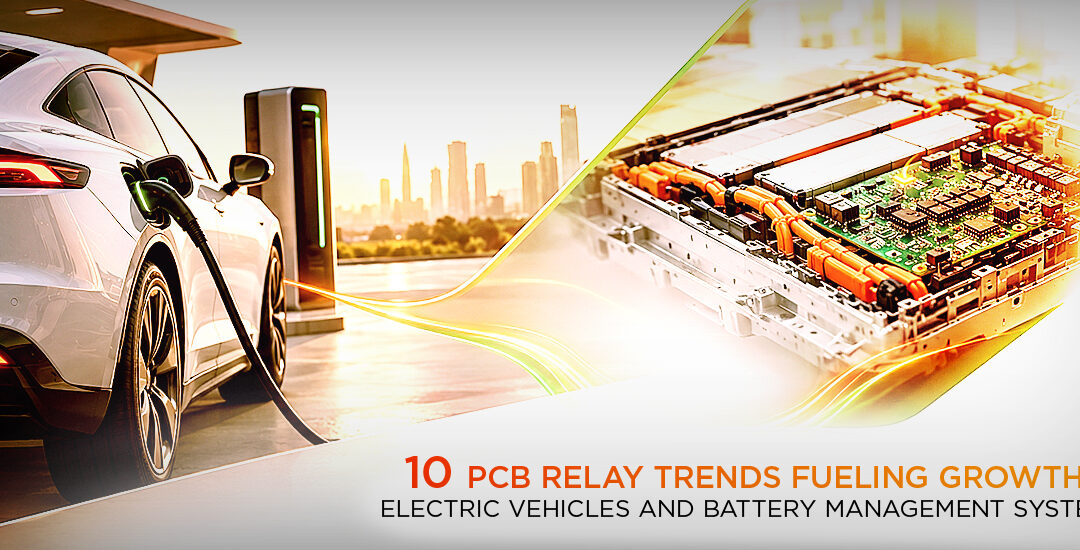
The rapid electrification of mobility is transforming the role of every electronic component inside an electric vehicle (EV). From battery monitoring and thermal management to charging, power distribution and auxiliary controls, modern EVs depend on compact and reliable switching technologies. This is creating new opportunities for the PCB Relay market, particularly as automotive electronics become smaller, smarter and more power-dense.
The latest IEA Global EV Outlook 2026, published in May 2026, reports that global electric car sales exceeded 20 million units in 2025, representing approximately 20% year-on-year growth. EVs accounted for 25% of all new cars sold worldwide. At the same time, EV battery deployment reached approximately 1.2 TWh in 2025.
These numbers demonstrate why relay technology is becoming increasingly important across EV and Battery Management System (BMS) architectures.
PCB Relay Trends Shaping EV and BMS Electronics
| Key indicator | Latest data | Why it matters |
| Global EV sales in 2025 | 20M+ units | Expands demand for automotive electronics |
| EV sales growth in 2025 | 20% YoY | Accelerates component demand |
| Global EV sales share | 25% | EVs are becoming mainstream |
| EV battery deployment in 2025 | 1.2 TWh | Expands BMS requirements |
| Expected battery deployment by 2030 | 3 TWh | Indicates continued long-term growth |
| EV relay market, 2026 estimate | $8.47 billion | Highlights growing relay opportunity |
| EV relay market CAGR, 2026–34 | 16.60% | Signals strong future expansion |
Sources: IEA Global EV Outlook 2026; Fortune Business Insights, 2026.
1. Miniaturisation Is Becoming a Core PCB Relay Requirement
EV manufacturers are continuously reducing the size and weight of electronic control units. This is increasing demand for relays that provide dependable switching without consuming excessive PCB space.
Modern miniature designs combine compact dimensions with efficient coil operation. For example, LeOne’s LST1 PCB relay measures just 12.5 × 7.5 × 10.3 mm, weighs approximately 2.2 g and offers a high-sensitivity 0.15 W coil option.
2. Low-Power Coils Support Energy-Efficient Electronics
Reducing parasitic energy consumption is increasingly important in EV electronics. Low-power coils can reduce thermal generation and electrical demand, particularly in control modules with frequent relay operation.
The move from conventional 0.2 W relay coils toward high-sensitivity 0.15 W designs illustrates how component-level optimisation can contribute to more efficient electronic architectures.
3. 400V and 800V Architectures Are Raising Switching Demands
EV platforms are moving toward higher-voltage architectures to support faster charging and reduce current requirements. This shift creates stricter requirements for insulation, contact configuration, and switching reliability.
As battery voltage increases, relay selection must consider parameters such as dielectric strength, contact capacity, creepage and clearance. Consequently, PCB and automotive relay manufacturers are developing solutions that can work alongside increasingly sophisticated high-voltage systems.
4. BMS Intelligence Is Increasing
A modern BMS monitors cell voltage, current, temperature, State of Charge (SoC) and State of Health (SoH), while coordinating charging and protection functions.
Recent 2026 research is also moving toward AI-assisted battery health assessment. A July 2026 study reported that physics-informed virtual sensing reduced capacity-loss prediction error by up to 39% and End-of-Life prediction error by 17%.
As BMS electronics become more intelligent, reliable switching components are required to work alongside sensors, microcontrollers, communication interfaces and power-management circuits.
5. Automotive Applications Are Expanding Beyond the Battery
PCB-mounted relays are not limited to BMS control. EVs contain electrically driven HVAC systems, cooling pumps, fans, actuators and other auxiliary systems.
Leone’s LMDC series, for example, supports PCB terminals and contact capacities up to 25A at 36VDC, with an operating temperature range of -40°C to +85°C. Its listed applications include electric control systems for electromobiles and accessories for high-voltage systems.
6. Higher Contact Capacity Is Becoming Important
As electrical loads increase, relay contacts must safely handle higher currents. Leone’s LHDC series supports ratings up to 55A at 60VDC, while maintaining a compact 32 × 26.5 × 23.5 mm form factor.
This combination of current capability and compact packaging is increasingly relevant for space-constrained EV control modules.
7. Faster Switching Supports Responsive Vehicle Controls
Modern electronic systems require predictable switching behaviour. The LHDC series specifies approximately 15 ms operate time and 15 ms release time, with mechanical life rated at 1 million cycles.
Such characteristics are valuable where relays are repeatedly used for auxiliary power and control functions.
8. Thermal and Environmental Reliability Are Critical
Battery compartments and electronic control units can experience temperature fluctuations, vibration, and electrical transients. Relay construction therefore needs to address insulation, contact stability, and environmental protection.
Leone’s high-voltage LH84-150A series, for example, offers IP67 protection and supports switching voltages up to 250VDC, demonstrating how automotive relay design is evolving toward more demanding environments.
9. Battery Growth Is Expanding the Component Opportunity
The IEA expects global EV battery deployment to reach almost 3 TWh by 2030, compared with around 1.2 TWh in 2025. That represents more than a doubling of annual battery deployment within five years.
More battery capacity means more BMS electronics, control circuits, charging infrastructure and auxiliary electrical systems creating a larger addressable market for switching components.
10. Reliability Is Becoming a Procurement Differentiator
As EV production scales, OEMs increasingly need components that combine electrical performance, consistent manufacturing and long service life. Relay selection is consequently shifting from simple cost comparison toward evaluation of contact life, coil power, insulation, operating temperature, switching capacity and application suitability.
For relay manufacturers, this makes engineering support, product consistency, and application-specific solutions increasingly important.
The Road Ahead for PCB Relay Technology
The EV transition is creating a broader and more technically demanding market for relays. From miniature BMS modules to higher-current auxiliary systems, the PCB Relay is evolving alongside the vehicle’s electrical architecture.
The key trends to watch are:
- Miniaturised relay packages for space-constrained PCBs.
- Low-power coils for energy-efficient control electronics.
- Higher contact capacities for growing electrical loads.
- Improved thermal and environmental performance.
- Faster and more reliable switching for responsive control.
- Greater compatibility with EV and BMS architectures.
- Automotive-focused reliability and quality requirements.
With EV sales already exceeding 20 million units annually and battery deployment projected to approach 3 TWh by 2030, the demand for dependable switching technologies is likely to remain strong.
For EV manufacturers and BMS designers, selecting the right PCB Relay is increasingly becoming an important part of achieving efficiency, reliability and long-term electronic system performance.
 English
 Afrikaans
 Albanian
 Amharic
 Arabic
 Armenian
 Azerbaijani
 Basque
 Belarusian
 Bengali
 Bosnian
 Bulgarian
 Catalan
 Cebuano
 Chichewa
 Chinese (Simplified)
 Chinese (Traditional)
 Corsican
 Croatian
 Czech
 Danish
 Dutch
 Esperanto
 Estonian
 Filipino
 Finnish
 French
 Frisian
 Galician
 Georgian
 German
 Greek
 Gujarati
 Haitian Creole
 Hausa
 Hawaiian
 Hebrew
 Hindi
 Hmong
 Hungarian
 Icelandic
 Igbo
 Indonesian
 Irish
 Italian
 Japanese
 Javanese
 Kannada
 Kazakh
 Khmer
 Korean
 Kurdish (Kurmanji)
 Kyrgyz
 Lao
 Latin
 Latvian
 Lithuanian
 Luxembourgish
 Macedonian
 Malagasy
 Malay
 Malayalam
 Maltese
 Maori
 Marathi
 Mongolian
 Myanmar (Burmese)
 Nepali
 Norwegian
 Pashto
 Persian
 Polish
 Portuguese
 Punjabi
 Romanian
 Russian
 Samoan
 Scottish Gaelic
 Serbian
 Sesotho
 Shona
 Sindhi
 Sinhala
 Slovak
 Slovenian
 Somali
 Spanish
 Sudanese
 Swahili
 Swedish
 Tajik
 Tamil
 Telugu
 Thai
 Turkish
 Ukrainian
 Urdu
 Uzbek
 Vietnamese
 Welsh
 Xhosa
 Yiddish
 Yoruba
 Zulu