
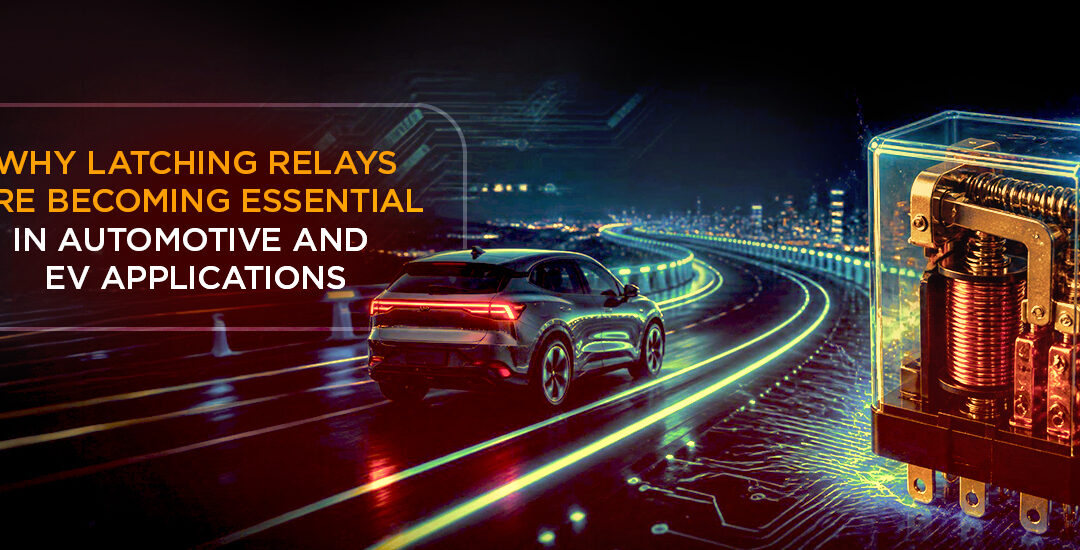
As electric vehicles (EVs), smart mobility systems, and next-generation automotive electronics continue to evolve, one component is quietly becoming indispensable across the industry the Latching Relay. While batteries, motors and charging systems often dominate headlines, automotive engineers are increasingly focusing on low-power, high-efficiency switching solutions that improve energy management and vehicle reliability.
According to the International Energy Agency (IEA), global EV sales crossed 17 million units in 2025, and analysts estimate EVs could account for over 25% of all new car sales worldwide by the end of 2026. This rapid electrification is driving demand for advanced relay technologies capable of handling high currents, minimizing energy consumption, and ensuring operational safety.
That is exactly where latching relays are transforming automotive and EV applications.
Unlike conventional relays that require continuous power to maintain their switching position, latching relays consume energy only during the switching process. This characteristic makes them highly suitable for modern automotive systems where energy efficiency, battery optimization, and thermal management are critical.
As Elon Musk once remarked:
“The future of transportation is electric.”
However, making that future practical and scalable requires intelligent electronic components working behind the scenes and latching relays are becoming one of them.
What Is a Latching Relay and Why Does It Matter?
A Latching Relay is an electromechanical switching device that maintains its contact position even after power is removed. Unlike standard relays that require continuous coil energization, latching relays use magnetic or mechanical memory to stay in their last state.
This operational advantage offers several key benefits for automotive and EV systems:
- Ultra-low power consumption
- Reduced heat generation
- Improved battery efficiency
- Enhanced reliability during power fluctuations
- Longer operational lifespan
- Better thermal stability in compact automotive architectures
In EV ecosystems, where every watt matters, these advantages directly impact vehicle range, energy optimization and system durability.
Why Automotive Manufacturers Are Rapidly Adopting Latching Relay Technology
1. Battery Efficiency Is Becoming a Top Priority
Modern EV manufacturers are under immense pressure to maximize battery range while reducing power losses across vehicle electronics.
Research published by the U.S. Department of Energy in late 2025 highlighted that auxiliary electronic systems can consume up to 8–12% of an EV’s stored battery energy under certain operating conditions. Reducing standby power consumption has therefore become a major engineering objective.
A latching relay significantly reduces parasitic power draw because it does not require constant current flow to remain activated.
For EV manufacturers, this means:
- Better energy conservation
- Reduced battery drain during idle conditions
- Increased driving range
- Improved battery lifecycle management
This is particularly important in modern EV architectures integrating advanced ADAS systems, infotainment modules, battery management systems (BMS) and onboard diagnostics.
How Latching Relay Solutions Improve EV Thermal Management
Lower Heat Generation Means Higher System Reliability
Thermal efficiency is one of the biggest challenges in EV engineering. Excessive heat affects battery performance, semiconductor reliability, and charging efficiency.
Since latching relays consume power only during switching operations, they generate substantially less heat compared to traditional continuously energized relays.
According to a 2026 automotive electronics market study by MarketsandMarkets, demand for low-heat electronic switching devices in EV platforms is expected to grow at a CAGR exceeding 10% through 2030.
This trend is accelerating adoption of latching relay systems across:
- EV battery disconnect units
- Charging infrastructure
- Smart fuse boxes
- Power distribution units (PDUs)
- High-voltage battery packs
- DC fast charging systems
Reduced heat generation also allows engineers to design more compact automotive electronic modules without compromising reliability.
The Growing Role of Latching Relay Systems in EV Charging Infrastructure
Fast Charging Requires Smarter Power Switching
The global EV charging infrastructure market is expanding rapidly. In January 2026, several automotive reports indicated that ultra-fast charging stations are becoming standard across Europe, China, India, and North America.
However, fast charging introduces major electrical challenges:
- High inrush currents
- Frequent switching cycles
- Elevated thermal stress
- Increased power distribution complexity
This is where latching relays deliver exceptional value.
Their ability to maintain switching states without continuous coil power improves energy efficiency inside charging stations while reducing operational heating.
In modern EV chargers, latching relay technology helps:
- Isolate battery circuits safely
- Control charging pathways
- Improve smart grid compatibility
- Enhance overload protection
- Reduce long-term maintenance costs
For automotive OEMs and charging infrastructure manufacturers, this translates into higher operational reliability and lower total ownership costs.
Why Smart Vehicles Need Intelligent Latching Relay Architectures
The Rise of Connected and Autonomous Mobility
Today’s vehicles are evolving into software-defined mobility platforms packed with intelligent electronics.
By 2026, premium EVs are expected to contain more than 3,000 semiconductor chips and dozens of distributed electronic control units (ECUs). Every subsystem – from seat controls to battery isolation depends on efficient switching mechanisms.
Latching relays are increasingly used in:
Battery Management Systems (BMS)
Reliable battery isolation is essential for EV safety. Latching relays ensure stable high-current switching while minimizing power loss.
Advanced Driver Assistance Systems (ADAS)
ADAS platforms require uninterrupted electronic performance. Low-power relay systems improve energy efficiency across distributed automotive electronics.
Smart Power Distribution Modules
Modern vehicles use intelligent power distribution architectures to dynamically control energy flow. Latching relays help reduce unnecessary energy consumption.
Emergency Disconnect Systems
During faults or collisions, rapid and reliable disconnection of battery systems is crucial. Automotive-grade latching relays support fast isolation capabilities.
Automotive Industry Trends Accelerating Latching Relay Adoption
Several 2025 and 2026 market developments are strengthening the importance of latching relays in automotive engineering:
EV Production Expansion
Global EV manufacturing capacity continues to rise rapidly, especially in India, China, Germany, and the United States.
Government Electrification Policies
Many governments are introducing aggressive EV adoption targets and stricter energy-efficiency standards for automotive electronics.
Increasing Demand for Energy-Efficient Components
Automakers are redesigning electronic architectures to reduce power losses and improve battery optimization.
Compact Vehicle Electronics
Modern EVs demand miniaturized, lightweight, and thermally optimized electronic systems.
These trends are directly supporting demand for automotive-grade latching relay technologies.
Why Leone Relay Is Positioned for the Future of Automotive Switching
As automotive electronics become more advanced, component reliability becomes mission-critical.
Leone Relay is focused on delivering high-performance relay solutions engineered for evolving industrial and automotive applications. With increasing demand for energy-efficient switching technologies in EV ecosystems, relay manufacturers must prioritize:
- Long electrical endurance
- Stable switching performance
- Compact relay architecture
- Thermal resistance
- High-current handling capability
- Low standby power consumption
Leone Relay understands the growing importance of intelligent switching solutions in the future of transportation and industrial automation.
By aligning with evolving automotive and EV market requirements, Leone Relay continues supporting industries seeking dependable, efficient, and future-ready relay technologies.
Conclusion: Why Latching Relay Technology Is No Longer Optional
The automotive industry is entering a new era defined by electrification, intelligent mobility, and energy optimization. As EV systems become more sophisticated, traditional switching technologies are struggling to meet modern efficiency demands.
A Latching Relay offers the ideal balance of low power consumption, thermal efficiency, operational reliability, and compact design, making it increasingly essential for automotive and EV applications.
From battery management systems and charging infrastructure to smart power distribution and vehicle safety systems, latching relays are becoming a foundational component in next-generation mobility.
Key Takeaways
- Latching relays consume power only during switching, improving EV battery efficiency.
- Reduced heat generation enhances automotive electronic reliability.
- EV charging infrastructure increasingly depends on intelligent relay architectures.
- Modern connected vehicles require low-power, high-reliability switching systems.
- Automotive electrification trends are accelerating global demand for latching relay technology.
- Leone Relay is aligned with the future needs of automotive and EV switching applications.
 English
 Afrikaans
 Albanian
 Amharic
 Arabic
 Armenian
 Azerbaijani
 Basque
 Belarusian
 Bengali
 Bosnian
 Bulgarian
 Catalan
 Cebuano
 Chichewa
 Chinese (Simplified)
 Chinese (Traditional)
 Corsican
 Croatian
 Czech
Czech Danish
 Dutch
Dutch Esperanto
 Estonian
 Filipino
 Finnish
 French
 Frisian
 Galician
 Georgian
 German
 Greek
Greek Gujarati
 Haitian Creole
 Hausa
Hausa Hawaiian
 Hebrew
 Hindi
Hindi Hmong
Hmong Hungarian
 Icelandic
 Igbo
Igbo Indonesian
 Irish
Irish Italian
 Japanese
 Javanese
 Kannada
 Kazakh
 Khmer
Khmer Korean
 Kurdish (Kurmanji)
 Kyrgyz
 Lao
Lao Latin
Latin Latvian
 Lithuanian
 Luxembourgish
 Macedonian
 Malagasy
 Malay
Malay Malayalam
 Maltese
 Maori
Maori Marathi
 Mongolian
 Myanmar (Burmese)
 Nepali
 Norwegian
 Pashto
 Persian
 Polish
 Portuguese
 Punjabi
 Romanian
 Russian
 Samoan
 Scottish Gaelic
 Serbian
 Sesotho
 Shona
Shona Sindhi
 Sinhala
 Slovak
 Slovenian
 Somali
 Spanish
 Sudanese
 Swahili
 Swedish
 Tajik
Tajik Tamil
Tamil Telugu
 Thai
Thai Turkish
 Ukrainian
 Urdu
Urdu Uzbek
Uzbek Vietnamese
 Welsh
Welsh Xhosa
Xhosa Yiddish
 Yoruba
 Zulu
Zulu