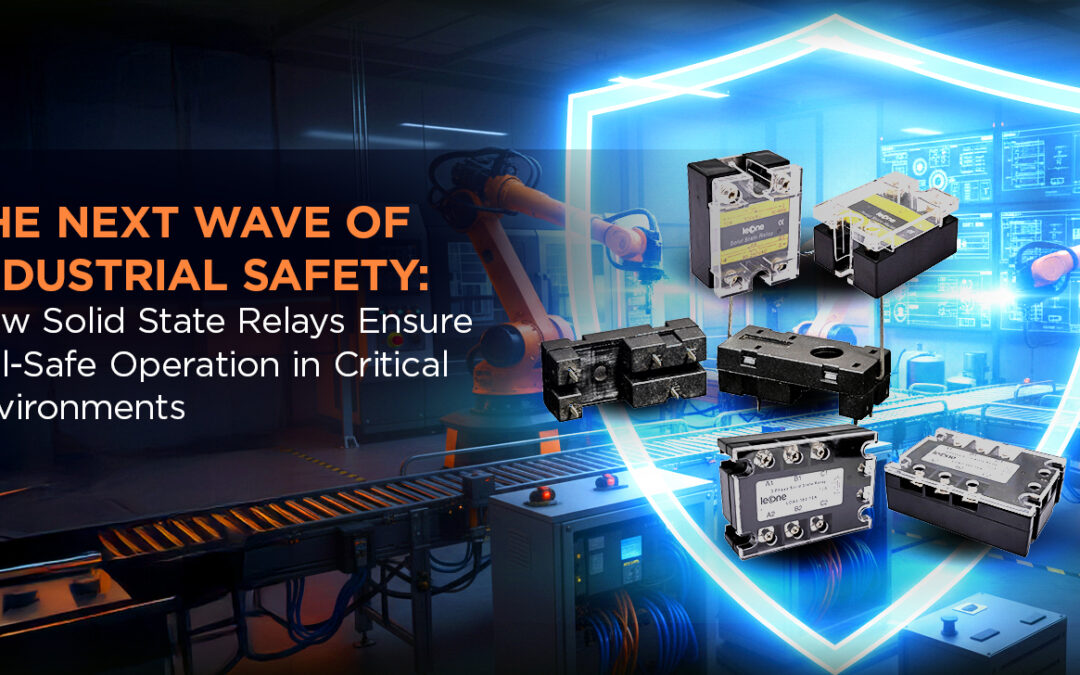
In today’s industrial world, where precision and uptime are the lifeblood of every operation, safety is evolving from a compliance checklist into a core design philosophy. With automation, smart factories and energy-intensive applications on the rise, the demand for systems that can think fast, react instantly and fail safely has never been higher. At the heart of this evolution lies a compact yet powerful device the Solid State Relay (SSR).
Unlike traditional electromechanical relays, SSRs have no moving parts, no contact wear and no delay. Their semiconductor-based design has made them the preferred choice in high-reliability sectors from manufacturing to power plants, railways to data centers. And as industries embrace the digital revolution, these devices are emerging as the silent guardians of industrial safety.
Redefining Industrial Safety Through Intelligent Switching
Industrial systems today operate in a complex ecosystem of automation, sensors and interconnected machinery. The stakes are higher than ever: a single failure can lead to downtime worth millions or, worse, compromise safety. According to a 2024 Research and Markets report, the industrial safety relays and timers market is projected to grow from USD 1.27 billion in 2024 to USD 2.34 billion by 2032, driven largely by automation and regulatory safety mandates.
This surge reflects a broader shift: industries are prioritizing reliability and fail-safe operation as competitive differentiators. That’s precisely where Solid State Relays are proving invaluable bridging the gap between high-performance control and uncompromised safety.
What Makes Solid State Relays the Backbone of Fail-Safe Systems
A Solid State Relay is an electronic switching device that uses semiconductors; like MOSFETs, thyristors, or triacs to perform the same function as a mechanical relay, but faster and more reliably. Unlike electromechanical versions that rely on physical contacts, SSRs use light or low-power control signals to trigger high-power circuits, resulting in:
- Instantaneous switching without contact bounce or arcing
- Silent operation and minimal electromagnetic interference
- Exceptional durability with lifespans exceeding tens of millions of cycles
- Resistance to vibration and shock ideal for harsh industrial settings
A 2024 paper in IEEE Access highlighted that SSRs reduce switching response time by up to 90% compared to mechanical relays, a crucial factor in safety-critical processes like motor control, robotic motion and thermal regulation. When milliseconds matter, SSRs help ensure that faults are isolated before damage occurs, embodying the true essence of fail-safe design.
Why Fail-Safe Architecture Demands SSR Integration
In critical sectors such as manufacturing, chemical processing, rail networks and renewable energy, reliability isn’t optional, it’s engineered into every layer. Fail-safe systems are designed to detect anomalies, isolate faults and revert to a safe state without human intervention.
SSRs play a central role here:
- Rapid Fault Isolation: With microsecond-level response, SSRs prevent cascading failures and enable instantaneous shutdown during overloads.
- Zero Mechanical Wear: No moving parts mean zero friction and predictable performance across years of operation.
- Thermal Protection: Modern SSRs integrate intelligent temperature sensors that cut off power automatically when heat exceeds safe thresholds.
- Seamless Redundancy: SSRs can be easily integrated into redundant circuits, enhancing compliance with global safety standards like IEC 62061 and ISO 13849-1.
A 2025 MDPI study on industrial automation safety noted that solid state switching technology reduces unplanned downtime by nearly 32%, translating into significant savings and improved operational resilience.
Market Momentum: The Rise of Solid State Relays in Industrial Safety
The global Solid State Relay market has entered a new growth phase. Recent research places its value at USD 1.47 billion in 2024, expected to reach USD 1.59 billion by 2025 expanding at a CAGR of 8.2%. This surge is driven by the transition from mechanical to electronic control systems, a rise in electric vehicle manufacturing and the growing demand for automation in high-risk industries.
Furthermore, a 2025 SkyQuest report emphasizes that Asia-Pacific remains the fastest-growing region for SSR adoption, with India leading innovations in compact, energy-efficient relay design for heavy industrial use. These numbers clearly reflect the world’s shift toward safer, smarter and more efficient control solutions, a shift powered by solid state technology.
Practical Considerations for Safe Solid State Relays Implementation
While the advantages of SSRs are undeniable, their deployment must follow best engineering practices to ensure long-term reliability:
- Select Appropriate Ratings: Choose SSRs rated precisely for your voltage, current and load characteristics.
- Incorporate Redundancy: Combine SSRs with safety contactors for added protection in critical circuits.
- Manage Heat Efficiently: Ensure proper heatsink design and ventilation to prevent thermal stress.
- Use Diagnostic-Enabled Models: Opt for SSRs with built-in monitoring and fault-detection to simplify predictive maintenance.
- Ensure Compliance: Integrate SSRs in alignment with safety standards (IEC 61508, ISO 13849-1) for certified system integrity.
By following these principles, industries can build control systems that not only perform optimally but also fail gracefully; ensuring human and machine safety at all times.
Leone Relay: Powering the Future of Safe Industrial Automation
Leone Relay has been at the forefront of relay innovation, engineering advanced Solid State Relays that combine precision, speed and dependability. Designed for diverse applications from industrial automation to power electronics; Leone’s SSRs are built to perform under extreme temperatures, vibrations and load conditions.
Each product is a testament to Leone’s philosophy: safety, reliability and innovation must go hand in hand. As industries evolve toward smarter and cleaner technologies, Leone Relay continues to deliver relay solutions that uphold the highest standards of operational safety and control.
Conclusion: The Silent Guardians of Industrial Safety
In the pursuit of efficiency and automation, Solid State Relays have emerged as the unsung heroes of industrial safety enabling systems that think, react and recover faster than ever before. Their seamless operation, high endurance and zero-failure design make them indispensable in achieving truly fail-safe environments.
Key Takeaways:
- SSRs deliver unmatched reliability and precision in safety-critical systems.
- The global shift toward automation and Industry 4.0 is accelerating SSR adoption.
- With proper integration and redundancy, SSRs can significantly reduce downtime and risk.
- Leone Relay continues to lead with advanced, durable and safety-compliant SSR solutions.
As industries move into an era defined by intelligence and automation, SSRs and brands like Leone Relay stand at the heart of this evolution, ensuring that every operation remains safe, seamless and future-ready.
 English
 Afrikaans
 Albanian
 Amharic
 Arabic
 Armenian
 Azerbaijani
 Basque
 Belarusian
 Bengali
 Bosnian
 Bulgarian
 Catalan
 Cebuano
 Chichewa
 Chinese (Simplified)
 Chinese (Traditional)
 Corsican
 Croatian
 Czech
Czech Danish
 Dutch
Dutch Esperanto
 Estonian
 Filipino
 Finnish
 French
 Frisian
 Galician
 Georgian
 German
 Greek
Greek Gujarati
 Haitian Creole
 Hausa
Hausa Hawaiian
 Hebrew
 Hindi
Hindi Hmong
Hmong Hungarian
 Icelandic
 Igbo
Igbo Indonesian
 Irish
Irish Italian
 Japanese
 Javanese
 Kannada
 Kazakh
 Khmer
Khmer Korean
 Kurdish (Kurmanji)
 Kyrgyz
 Lao
Lao Latin
Latin Latvian
 Lithuanian
 Luxembourgish
 Macedonian
 Malagasy
 Malay
Malay Malayalam
 Maltese
 Maori
Maori Marathi
 Mongolian
 Myanmar (Burmese)
 Nepali
 Norwegian
 Pashto
 Persian
 Polish
 Portuguese
 Punjabi
 Romanian
 Russian
 Samoan
 Scottish Gaelic
 Serbian
 Sesotho
 Shona
Shona Sindhi
 Sinhala
 Slovak
 Slovenian
 Somali
 Spanish
 Sudanese
 Swahili
 Swedish
 Tajik
Tajik Tamil
Tamil Telugu
 Thai
Thai Turkish
 Ukrainian
 Urdu
Urdu Uzbek
Uzbek Vietnamese
 Welsh
Welsh Xhosa
Xhosa Yiddish
 Yoruba
 Zulu
Zulu